



Last updated: 24 April 2026

Development length is one of the most important concepts in reinforced concrete design, as it ensures that steel bars are properly anchored inside concrete to safely transfer stress without slipping. As per Bureau of Indian Standards IS 456:2000, the correct development length must be provided in beams, columns, footings, slabs, and beam-column joints to achieve full bond strength between steel and concrete. If insufficient length is provided, cracks, bar pull-out, or structural failure may occur.
In this article, we explain the development length formula as per IS 456, calculation steps, values for Fe415 and Fe500 steel, and practical requirements for beam, footing, and column with easy examples.
What is Development Length?
A development length can be defined as the length of the reinforcement bar needed to be embedded or projected into the column to establish the desired bond strength between the concrete and steel (or any other two types of material).
Development Length Formula (IS 456)
As per IS 456:2000, the development length is calculated using the formula:
Where:
- \( L_d \) = Development length (mm)
- \( \phi \) = Diameter of bar (mm)
- \( \sigma_s \) = Stress in bar at section (N/mm²)
- \( τ_{bd} \) = Design bond stress (N/mm²)
Importance of Development Length
Providing sufficient required embedment at column–footing and column–beam junctions is crucial for achieving effective anchorage of reinforcement bars. It ensures adequate bond between steel and concrete, enabling proper stress transfer and preventing premature failure due to bar slippage. The following are the key reasons for its provision.
- Ensuring the bar’s stability within the concrete and preventing any displacement.
- Preventing any potential damage caused by the bar sliding under extreme loads.
- Facilitating the transfer of pressures generated in one area to neighbouring sections by incorporating additional bar length, as specified in the production length at the column.
- The specified length at the beam-column junction allows for the effective transfer of stresses through the steel bond, facilitating the transfer of forces.
Design bond stress for plain steel bar and HYSD steel bar in the limit state is given in Table 1 and Table 2 according to IS 415:2000. For deformed bars, increase bond stress by 60% and for bars in compression, increase bond stress by 25%.
| Grade of concrete | M15 | M20 | M25 | M30 | M35 | M40 and above |
|---|---|---|---|---|---|---|
| Design bond stress, \( \style{font-family:’Times New Roman’}{\style{font-size:18px}{\tau_{bd}}} \), N/mm2 | 1.0 | 1.2 | 1.4 | 1.5 | 1.7 | 1.9 |
| Grade of concrete | M15 | M20 | M25 | M30 | M35 | M40 and above |
|---|---|---|---|---|---|---|
| Design bond stress, \( \style{font-family:’Times New Roman’}{\style{font-size:18px}{\tau_{bd}}} \), N/mm2 | 1.6 | 1.92 | 2.24 | 2.4 | 2.72 | 3.04 |
Also, read: Types of Steel Reinforcement Bars
Calculation of Development Length
For the calculation of Ld, let’s first consider the grade of concrete as M20 grade and steel as Fe415.
σs = 0.87 x 415
= ( ø x 0.87 x 415 ) / ( 4x 1.92 )
Ld = 47.012ø ~ 47ø
Therefore, Ld = 47ø …eq5
The bar of 20 mm diameter is simply the multiplication of 47 by the diameter of the bar.
=47 x 20
=940 mm
Development length for various grades of concrete and Steel Bar
The values of design bond stress in tension and the Ld value for plain mild steel bars and HYSD-steel bars for different grades of concrete as specified in IS: 456–1978 are given in the Table below.
| Grade of Concrete | Plain Mild Steel Bars \( f_y \)=250 N/mm2 | Plain Mild Steel Bars \( f_y \)=415 N/mm2 | ||
|---|---|---|---|---|
| τbd | Ld | Zu | Ld | |
| M15 | 1.00 | 54.375Ø | 1.60 | 56.414Ø |
| M20 | 1.20 | 45.313Ø | 1.92 | 47.012Ø |
| M25 | 1.40 | 38.839Ø | 2.24 | 40.296Ø |
| M30 | 1.50 | 36.250Ø | 2.40 | 37.185Ø |
| M35 | 1.70 | 31.985Ø | 2.72 | 33.185Ø |
| M40 | 1.90 | 28.618Ø | 3.04 | 29.692Ø |
Development Length for Fe500
| Grade of Concrete | Design Bond Stress for Plain Bars in Tension, τbd (N/mm²) | τbd for Fe500 Deformed Bars in Tension (×1.6) | Development Length in Tension, Ld | τbd for Fe500 Deformed Bars in Compression (×1.6 × 1.25) | Development Length in Compression, Ld |
|---|---|---|---|---|---|
| M20 | 1.20 | 1.92 | 56.6Ø | 2.40 | 45.3Ø |
| M25 | 1.40 | 2.24 | 48.5Ø | 2.80 | 38.8Ø |
| M30 | 1.50 | 2.40 | 45.3Ø | 3.00 | 36.3Ø |
| M35 | 1.70 | 2.72 | 40.0Ø | 3.40 | 32.0Ø |
| M40 and above | 1.90 | 3.04 | 35.8Ø | 3.80 | 28.6Ø |
Here, Ø = bar diameter. The Table 21 base bond-stress values for M20, M25, M30, M35, and M40+ are 1.2, 1.4, 1.5, 1.7, and 1.9 N/mm², respectively.
Engineers often search for a quick development length table for Fe500 steel, so the table below provides ready-to-use approximate values for beam, footing, and column design in M20 to M30 concrete grades.
| Bar Diameter | M20 Tension | M25 Tension | M30 Tension | M20 Compression | M25 Compression | M30 Compression |
|---|---|---|---|---|---|---|
| 12 mm | 680 mm | 582 mm | 544 mm | 544 mm | 466 mm | 435 mm |
| 16 mm | 906 mm | 776 mm | 725 mm | 725 mm | 621 mm | 580 mm |
| 20 mm | 1132 mm | 970 mm | 906 mm | 906 mm | 776 mm | 725 mm |
| 25 mm | 1415 mm | 1213 mm | 1133 mm | 1133 mm | 970 mm | 906 mm |
As the concrete grade increases, the required development length reduces.
Factor Influencing Development Length
Several factors affect the bond length, and it’s essential to consider these factors for designing structurally sound and safe constructions. Here are some of the key factors:
1. Diameter of Bar \( \phi \)
Development length is directly proportional to the diameter of the reinforcement bar. Larger diameter bars carry greater tensile force, and therefore require a longer embedded length to safely transfer stress to the surrounding concrete.
2. Stress in Steel (\( \sigma_s \)):
The development length increases with the stress in the reinforcement. Higher tensile stress in the bar demands a greater bond resistance, resulting in an increase in the required development length.
3. Grade of Steel (\( f_y \)):
The higher-grade steel has greater yield strength, which increases the stress developed in the bar. As a result, the required \(L_d\) also increases to ensure proper stress transfer.
4. Bond Stress (τbd):
It is inversely proportional to the design bond stress between steel and concrete. Higher bond stress provides better grip between the reinforcement and the surrounding concrete, thereby reducing the required \(L_d\).
5. Grade of Concrete:
The concrete with a higher grade offers improved bond strength with reinforcement. This enhances the bond stress, which in turn reduces the \(L_d\) required for proper anchorage.
6. Types of Reinforcement Bar:
Deformed (ribbed) bars provide better mechanical interlock with concrete compared to plain bars. Consequently, deformed bars require a shorter \(L_d\), while plain bars require a longer length for adequate anchorage.
7. Stress Condition (Tension or Compression)
Development length is generally higher for bars in tension due to the greater likelihood of bond failure. As per IS 456:2000, the design bond stress for bars in compression is taken as 25% higher than that for bars in tension. Consequently, the required \(L_d\) in compression is comparatively less.
- IS 456 explicitly states: Bond stress in compression = 1.25 × bond stress in tension
- For compression bars:
Recommended Reading: Compressive Strength Of Concrete
Development Length for Bundled Bars
When reinforcement bars are placed in contact (bundled together) instead of being spaced apart, the effective bond between concrete and each individual bar is reduced. This happens because:
- Some surface area of each bar is not in direct contact with the concrete
- Bond stress cannot fully develop around the entire circumference of each bar
As per IS 456:2000 clause no 26.2.1.2, bars in bundle, the development length increases as:
- For 2 bars in contact: Increase by 10%
- For 3 bars in contact: Increase by 20%
- For 4 bars in contact: Increase by 33%
Types of Development Length
1. Bond Development Length
Bond development length refers to the distance along the length of a reinforcing bar (rebar) over which the bar provides adequate bond or adhesion to the surrounding concrete. When concrete is subjected to loads, such as tension or compression, the reinforcing bars within it are responsible for carrying these loads. The bond development length is the distance required to ensure that the stresses transferred between the concrete and the reinforcing bar are effectively distributed.
2. Anchorage Length
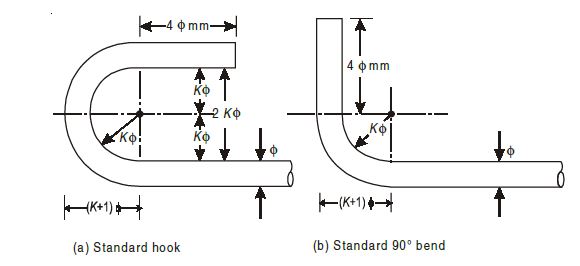
The anchorage length shall be considered while providing the reinforcement bar at the junction and critical section of the structure members, such as footing, slabs and staircase. The anchorage length is provided in the tension and compression bar by either a standard hook or a bend. The standard hook and bend are provided as shown in Figure 2.
Read also: How To Calculate Unit Weight of Steel Bar
2.1. Anchorage Length of The Tension Bar
The anchorage length is not necessarily provided to the tension bar when HYSD steel is used. Hooks are provided for plain bars in tension. Bends and hooks shall conform to IS 2502.
Bend: – The anchorage value should be set to 4 times the diameter of the bar, for each 45° bend subjected to a maximum of 16 times the diameter of the bar.
Hook: – The anchorage value of a standard U-type hook shall be equal to 16 times the diameter of the bar.
2.2. Anchorage Length of The Compression Bar
This is the minimum length of the bar provided at the junction of the beam and column to prevent the failure of the joints under certain loading conditions. The anchorage length of the compression bar should be equal to the development length. The total length of anchorage length should include a hook, bent and straight length of the bar if provided.
3. Lap Splice Length
This is the portion where the main bar gets terminated due to inadequate length and continues with the same properties as the other bar. These bars are joined either by overlapping each other, and the region of lapping is simply known as lapping. The length of the lapping is equal to the development length in tension reinforcement bars.
Read also: What are Structural Steels?: Types and thier application
Practical Notes on Development Length
Proper bar anchorage and lap placement are critical during construction. These lengths should be checked at beam supports, column joints, footings, and other high-stress zones to ensure safe load transfer. Bars should not be cut short or lapped at random locations, as this may cause slip or cracking. Always follow structural drawings, BBS, and code requirements. Some important practical site notes are given below.
1. Check Development Length at Critical Locations
The development length must be carefully ensured at the critical structure location, such as column–footing junctions, beam–column junctions, and beam supports. These regions are subjected to high stress and are particularly vulnerable to bond failure. Therefore, providing adequate anchorage at these locations is essential to ensure proper load transfer and overall structure safety.
- Column–footing junction
- Beam–column junction
- Supports in beams
2. Use Hooks or Bends When Space is Limited
In congested regions such as beam–column or column–footing junctions, providing the full development length may not be feasible. In such cases, standard hooks or bends (90° or 135°) are used to achieve the required anchorage.
3. Avoid Curtailment in High-Stress Zone
Reinforcement bars should not be terminated in regions of high bending moment or shear. Adequate development length must be provided beyond critical sections to ensure proper stress transfer.
4. Prefer Deformed Bars for Better Bond
Deformed (ribbed) bars provide superior mechanical interlock with concrete compared to plain bars. This improves bond strength and reduces the required development length.
5. Provide Additional Length as a Safety Margin
In practice, the site engineer often provides slightly more than the calculated development length to account for construction tolerances, variations in concrete quality, and possible workmanship issues.
What Happens If All Lap Splices Fall in the Same Zone of a Beam?
When all lap splices are placed in the same zone of a beam, the section becomes weak because many bars are discontinuous at one location. This can reduce bond strength, increase cracking, and create congestion during concreting. As per good practice and IS 456 principles, lap splices should be staggered and avoided in maximum stress zones such as midspan tension zones or near supports, depending on bar location. If unavoidable, consult the structural engineer and revise detailing.
What to Do If All Lap Splices Fall in One Zone
When all lap splices fall in one beam zone, and shifting is difficult due to bar length, congestion, or site constraints, corrective detailing should be adopted. Major design codes such as IS 456, ACI 318, and Eurocode 2 generally recommend proper splice location, confinement, and staggering to maintain structural safety.
1. Do Not Lap All Bars at the Same Section
Providing lap splices for all reinforcement bars at one exact section creates a weak plane in the beam. At that location, several bars are discontinuous, reducing force transfer efficiency and increasing cracking risk. Good detailing practice under IS 456 and international codes is to avoid concentrating splices in one section, especially in heavily stressed regions. Splices should be distributed so the beam does not lose capacity locally.
2. Stagger Splice Positions of Alternate Bars
Instead of lapping all bars together, splice alternate bars at different locations along the beam length. This is one of the most common and accepted site solutions. By staggering the laps, only some bars are spliced at one section, while the remaining continuous bars still carry tensile force. This improves load transfer and reduces stress concentration. ACI 318 and Eurocode detailing practices also favour staggered splices for better structural behaviour.
3. Use Mechanical Couplers in Congested Areas
Where reinforcement is heavily congested and proper lap length cannot be achieved, mechanical couplers may be a better solution. Couplers connect two bars directly without a long overlap length, reducing steel crowding and improving concrete placement. They are widely accepted in modern projects when approved by the structural engineer and tested as per project specifications. Couplers are especially useful in beam-column joints and heavily reinforced beams.
4. Provide Additional Stirrups in the Splice Zone
Lap splice regions experience bond stresses that can cause splitting cracks in the surrounding concrete. Providing closer or additional stirrups around the splice zone helps confine the concrete and improve bond performance. This is consistent with the confinement principles recognised in ACI 318 and Eurocode 2. Extra stirrups also improve crack control and ductility in the lap region.
5. Avoid Maximum Tension Zones Whenever Possible
Lap splices should not be concentrated in zones of maximum tensile stress. For simply supported beams, bottom bars near midspan are highly stressed. For continuous beams, top bars near supports may be critical. IS 456 encourages locating splices away from sections of maximum moment whenever practical. Moving laps to lower stress regions greatly improves performance and safety.
6. Providing Additional Reinforcement
Providing one additional continuous reinforcement bar between supports can be practical remedial measure when all lap splices fall in the same beam zone, provided it is specifically approved by the structural designer. This extra bar helps improve continuity of reinforcement across the span and reduces the weakness created when several bars are spliced at one location.
Derivation of Development Length: For students
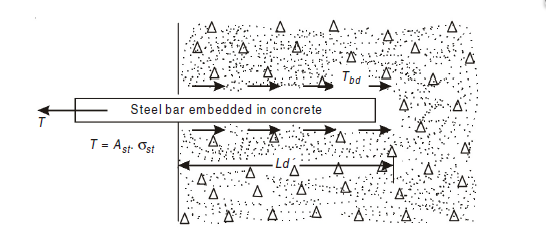
A steel reinforcement bar is embedded in concrete, as shown in Figure 1. When the bar is subjected to tension, it develops a tensile force which must be resisted by the bond between the steel and the surrounding concrete.
The derivation is based on the equilibrium between tensile force in steel and bond resistance developed along the embedded length.
Step 1: Tensile Force in Steel
The tensile force carried by the bar is:
Step 2: Bond Resistance from Concrete
The bond force developed along the surface of the bar acts in the opposite direction and is given by:
Step 3: Equilibrium Condition
For the equilibrium of the bar:
Tensile Force=Bond Resistance
Step 4: Final Expression
Frequently Asked Questions
Q: What is the development length?
Answer: Development length is the length of the reinforcement bar that is required to be embedded into the concrete to develop the full tensile capacity of the bar.
Q: What is the formula to calculate development length?
Answer: The formula to calculate development length is given by:
\( L_d=\frac{\phi.\sigma_s}{4.\tau_{bd}} \)
where,
Ld = Development Length
ø = Diameter of steel bar
σs = Stress of steel bar
\( \style{font-family:’Times New Roman’}{\style{font-size:18px}{\tau_{bd}}} \) = Design bond Stress
Q: What is the minimum development length for the reinforcement bar?
Answer: The minimum development length of the reinforcement bar is calculated by using the formula 47ø for the fy415 and M20 grades of concrete. Where ø is the diameter of the bar.
Q: Why is development length important in reinforced concrete design?
Answer: Development length is important because it ensures that the full tensile capacity of the reinforcement bar is utilised to resist the applied load. If the development length is insufficient, it can result in premature failure of the concrete element.
Q: What factors affect development length?
Answer: The development length depends on bar diameter, stress in steel, and bond stress between steel and concrete.
Q: Is the development length different for tension and compression bars?
Answer: Yes, development length differs for tension and compression bars. In tension, a longer development length is required because the bond between steel and concrete is more critical to prevent bar slippage. In compression, the bond stress is higher, so the required development length is comparatively reduced as per IS 456:2000.
References & Standards
- ACI 318-11. (August 2011). Building Code Requirements for Structural Concrete
- Indian Standard. (2000). Code of Practice for Plain and Reinforced Concrete (IS 456:2000) (4th ed.).
- Bureau of Indian Standards. (2016). Indian standard ductile design and detailing of reinforced concrete structures subjected to seismic forces (IS 13920:2016).
- Indian Standard. (1963). Code of Practice for Bending and Fixing of Bars for Concrete Reinforcement (IS 2502-1963).
- Bhavikatti, S.S. (2016). Design of RCC Structure Elements (RCC Volumn-I) (2nd ed). New Age International Publishers.
- Chandra, R. (2013). Reinforced Concrete Structure (limit State Design). Rajinder Kumar Jain
- Housing News. (2023). Development length formula: Know meaning and calculation. Housing News. https://housing.com/news/what-is-development-length-in-construction-work/
- Mishra, G. (2018). Development Length of Reinforcement Bars. The Constructor. https://theconstructor.org/structural-engg/development-length-reinforcement-bars/1344/