

Last updated: 3 May 2026

Introduction
Brick bonds are the arrangement patterns of bricks in masonry walls to improve strength, stability, and appearance. Different brick bond types, such as English bond, Flemish bond, stretcher bond, and header bond, are selected based on wall thickness, load, and architectural finish.
In this guide, we explain 11 common brick bonds with uses, diagrams, and differences.
What is Brick Bond in Masonry?
Brick bond in masonry is the interlacement of bricks, formed when they lie immediately below or above them. It is the method of arranging the bricks in courses so that individual units are tied together, and the bricks are vertical joints of the successive courses that do not lie in the same vertical line. Get a complete breakdown in our guide on Types of Bricks Used in Building Construction
Why is Bonding Important in Brickwork?
Bonding is important in brickwork because it properly interlocks the bricks to form a strong, stable, and durable wall. A good brick bond helps distribute loads evenly, prevents continuous vertical joints, improves resistance to cracking, and enhances the overall appearance of the masonry. It also increases the wall’s strength against lateral forces such as wind and minor movement. Learn more in our complete guide on Masonry in Construction.
Rules for Bonding in Bricks
For getting good bonding, the following rules should be observed:
- The bricks should be of uniform size. The length of the brick should be twice its width plus one joint, so a uniform lap is obtained. A good bond is not possible if the lap is non-uniform.
- The amount of lap should be a minimum of 1/4 brick along the length of the wall and 1/2 brick across the thickness of the wall.
- The use of brickbats should be discouraged, except in special locations.
- In the alternate course, the centre line of the header should coincide with the centre line of the stretcher; the course should be below or above it.
- The vertical joints in the alternative courses should be along the same perpendicular.
- The stretchers should be used only in the facing; they should not be used in the hearing. Hearting should be done in headers only.
- It is preferable to provide every sixth course as a header course on both sides of the wall.
Quick Comparison Table of Brick Bond Types
| Bond Type | Strength | Appearance | Common Use |
|---|---|---|---|
| English Bond | High | Medium | Load-bearing walls |
| Flemish Bond | Medium | High | Facing walls |
| Stretcher Bond | Low | Good | Partition walls |
| Header Bond | Medium | Basic | Curved walls |
| Garden Wall Bond | Medium | Decorative | Boundary walls |
1 Types of Brick Bonds in Masonry Construction
The following are the types of bonds in brick wall construction:
Stretcher bond
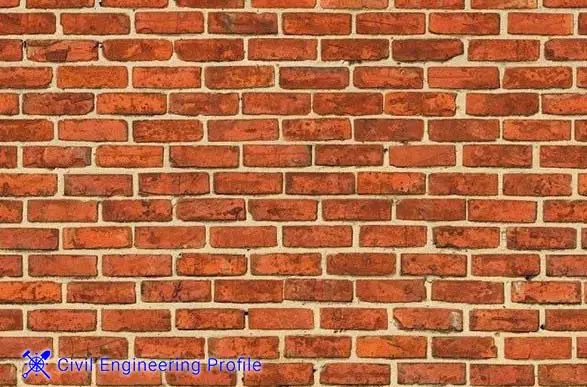
A Stretcher bond is one in which all the bricks are laid as stretchers on the face of walls. The length of the bricks is thus along the direction of the wall. This pattern is used only for those walls which have a thickness of half a brick (i.e. 90 mm), such as those used as partition walls, sleeper walls, division walls or chimney stacks. The bond is not possible if the thickness of the wall is more.
Header Bond
A header bond is one in which all the bricks are laid as headers on the face of the walls. The width of the bricks is thus along the direction of the wall. The pattern is used only when the thickness of the wall is equal to one brick (i.e. 180 mm). The overlap is usually kept equal to half the width of the brick (i.e. 4 1/2 cm). This is achieved by using three-quarter brickbats in each alternate course as quoins.
This bond does not have the strength to transmit pressure in the direction of the length of the wall. Such bonding in bricks is not suitable for load-bearing walls. However, the bond is especially useful for curved brickwork where the stretchers, if used, would project beyond the face of the wall and would necessitate inconvenient cutting. This is also used in the construction of a footing.
English Bond
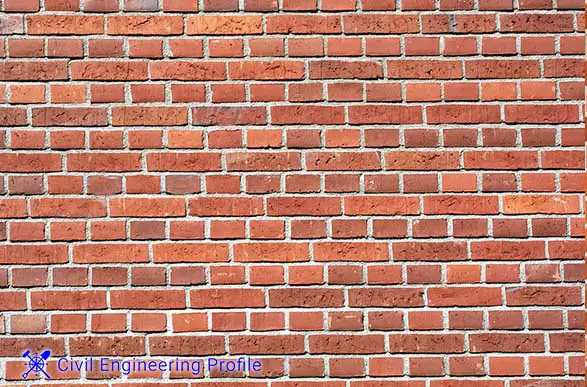
This type of bond in brickwork is the most commonly used in brick wall construction. This is suitable for all wall thicknesses. This bond is considered to be the strongest. The band consists of an alternative course of headers and stretchers. In this bond, the vertical joints of the header course come over each other; similarly, the vertical joints of the stretcher courses also come over each other. In order to break the vertical joints in the successive courses, it is essential to place the queen closer after the first header (quoin header) in each heading course.
Recommended Reading: 4 Types of Seismic Bands for Masonry Structure: Horizontal bands, Advantages and Disadvantages
Flemish Bond
In this type of bond, each course is comprised of alternate headers and stretchers. Every alternate course starts with a header at the corner (i.e. quoin header). Quoin closers are placed next to the quoin header in an alternate course to develop the face lap. Every header is centrally supported over the stretcher below it. Flemish bonds are of two types:
- Single Flemish bond
- Double Flemish bond
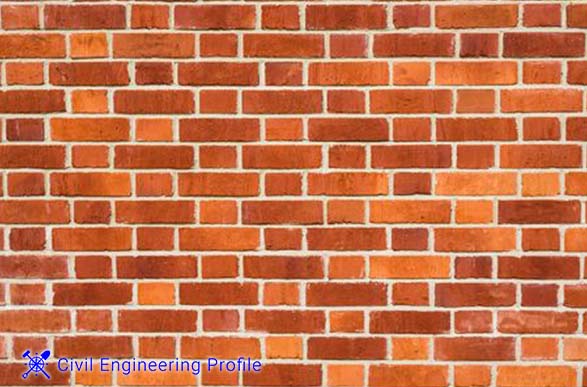
A single Flemish bond is the combination of a double Flemish bond and an English bond. This bond uses the strength of the English bond and the appearance of the Flemish bond. A single Flemish bond can be used for those walls having a thickness at least equal to 1 1/2 bricks. Double Flemish bond facing is done with good-quality, expensive bricks. However, cheaper bricks can be used for backing and hearting.
Unlike the Single Flemish bond, the Double Flemish bond consists of the same appearance both in the front and in the back. Alternate headers and stretchers are laid in each course. It has a better appearance and presentation than English bonds.
Facing Bond
This bond is used where bricks of different thicknesses are to be used in the facing and backing of the wall. In this bond, a header course is provided after several stretcher courses. Since the thickness of bricks is different in the facing and backing, the virtual distance between the successive header courses is kept equal to the least common multiple of the thickness of backing and facing bricks.
Recommended Reading: Types of Bricks Used in Building Construction: 6 Types of Bricks
English Cross Bond
This is the modification of the English Bond. It is done to improve the appearance of the wall. English cross bond combines the requirements of beauty and strength. The special features of the bond are as follows:
- Alternative courses of headers and stretchers are provided as in English bond.
- Queen closers are placed next to quoin headers.
- A header is introduced next to the quoin stretcher in every alternate stretcher course.
Brick On Edge Bond
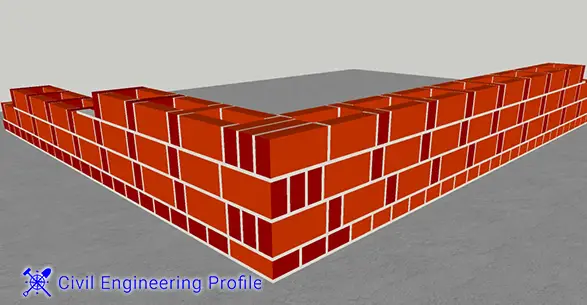
This type of bond in brick is also known as Silverlock’s bond or Soldier’s course. The type of bond uses stretcher bricks on the edges instead of a bed. This bond is weak in strength but is economical. Hence, it is used for garden walls, compound walls, etc. Bricks are kept standing vertically on the end. These bricks are arranged as headers and stretchers in such a manner that headers are placed on the bed, and stretchers are placed on the edge, thus forming a continuous cavity. Due to this, the bond consumes fewer bricks, making it economical.
Dutch Bond
This is another type of modified English bond. In this bond, the corners of the wall are strengthened. Special features of this type of bond are as mentioned below:
- Alternate courses of headers and stretchers are provided as in the English bond.
- Every stretcher course starts at the quoin with a three-quarter bat.
- In every alternate stretcher course, a header is placed next to the three-quarter brick bat provided at the quoin.
Raking Bond
Raking bonds are used in thick walls. In this type of bond in brick, the bonding bricks are kept at an inclination to the direction of the wall. Due to this, the longitudinal stability of the thick walls built in English bonds is very much increased. This bond is introduced at certain intervals along the height of the wall. The following are special features of ranking bonds:
- The bricks are arranged in an inclined direction, in the space between the external stretchers of the wall.
- The raking or inclination should be in the opposite direction in alternate courses of the raking bond.
- Ranking bond is not provided in successive courses. It is provided at a regular interval of four to eight courses at the height of a wall.
- The raking course is generally provided between the two stretcher courses of the wall having a thickness equal to an even multiple of half bricks, to make the bond more effective.
Ranking bonds are of two types:
- Diagonal bond and
- Herringbone bond
Zig Zag Bond
Bonds in bricks are similar to herring-bone bonds, except that the bricks are laid in a zig-zag fashion. This bond is commonly used for making ornamental panels in brick flooring.

Recommended Reading: How To Lay Brick Flooring On Concrete Base
Garden Bond
As the name suggests, this type of bond is used for the construction of garden walls, boundary walls, compound walls, etc. The thickness of the wall is one brick thick, and the height does not exceed two meters. Such a type of bond is not as strong as an English bond. However, the bond has an attractive appearance. Due to this reason, it is sometimes used in the construction of outer leaves of cavity walls. Garden wall bonds are of the following three types:
- Garden wall English bond
- Garden wall Flemish bond
- Garden wall Monk bond
English Bond vs Flemish Bond
| Feature | English Bond | Flemish Bond |
|---|---|---|
| Strength | Higher | Moderate |
| Appearance | Simple | Better |
| Labour Skill | Easier | Higher skill |
| Use | Structural walls | Facing walls |
Which Brick Bond is Strongest?
English Bond is generally considered one of the strongest traditional brick bonds because alternate header and stretcher courses provide good interlocking, proper lap, and fewer continuous vertical joints. This arrangement improves load distribution and wall stability, making it widely used for load-bearing walls and heavy masonry construction.
Which Brick Bond is Best for House Construction?
Choosing the right brick bond can improve both the structural strength and aesthetic appearance of a house wall. The best bond depends on the location, purpose, and thickness of the wall.
- English Bond: Preferred where higher strength and durability are required. It is commonly used for load-bearing walls and main structural walls.
- Flemish Bond: Chosen where appearance is important. It provides an attractive finish and is commonly used for exposed external walls, facades, and boundary walls.
- Stretcher Bond: Commonly used for half-brick-thick partition walls and non-load-bearing internal walls. It is economical and easy to construct.
★ Important Note: For most residential houses, a combination of bonds may be used depending on structural and architectural requirements.
How to Select the Right Brick Bond?
Selecting the right brick bond depends on several practical and structural requirements. The most suitable bond should be chosen based on wall function, appearance, cost, and construction feasibility.
- Wall Thickness: Some bonds are better suited for half-brick walls, while others are used for one-brick or thicker walls.
- Load Requirement: Load-bearing walls require stronger bonds, such as English Bond.
- Architectural Finish: If appearance is important, Flemish Bond is often preferred.
- Cost and Labour Skill: Decorative bonds may require more skilled labour and a higher construction cost.
- Type of Structure: Residential houses, boundary walls, partition walls, and decorative walls may require different bond types.
★ Tip: Choosing the correct brick bond helps achieve better strength, durability, and visual appeal in masonry construction.
Common Mistakes in Brick Bonding
Several common mistakes should be avoided to maintain the structural integrity, durability, and appearance of brick masonry walls. Poor bonding practice can lead to cracks, weak walls, and an uneven finish.
- Continuous Vertical Joints: Vertical joints should be staggered properly. Continuous joints reduce wall strength and may cause cracking.
- Poor Lap Length: Insufficient overlap between bricks weakens the bond and affects load transfer.
- Uneven Mortar Joints: Irregular mortar thickness can cause poor alignment and uneven stress distribution.
- Wrong Bond Selection: Using an unsuitable bond for wall thickness or load condition may reduce performance.
- Poor Alignment: Improper line, level, and plumb can affect both wall stability and appearance.
★ Important Note: Proper supervision and quality workmanship are essential for achieving strong, durable, and well-finished brick masonry construction.
Recommended Reading:
Frequently Asked Questions
Q: Why is Flemish bond popular?
Answer: Because of its decorative appearance.
Q: Which bond is strongest in brick masonry?
Answer: English Bond is generally known as the strongest. This is due to its composition, where alternating courses comprise both header and stretcher bonds.
Q: Which bonding is suitable for cavity walls?
Answer: Garden bond is sometimes used for the construction of outer leaves of cavity walls due to its appealing appearance. The common type of bond used for cavity walls is a stretcher bond for both inner and outer leaves.
Q: Which bond is used for paving?
Answer: Herringbone Bond and zigzag bond.
Q: Which bond is used for partition walls?
Answer: Stretcher Bond.
Conclusion
Brick bonds play an important role in masonry strength, durability, and appearance. Selecting the correct bond type helps ensure better wall performance and long-term stability.
References & Standards
- SP 62 (S & T): 1997. Handbook on Building Construction Practices. BIS. New Delhi
- Punima, Dr B. C. (2006). Building Construction. Luxmi Publication (P) Limited.
- Types of brick bonding. (n.d.). Designing Buildings. https://www.designingbuildings.co.uk/wiki/Types_of_brick_bonding


Very much informative. Thanks
Thanks. You might have seen many types of bond in brick works after going through this post.