


Last updated: 19 May 2026

Introduction
Traditional surveying methods can be time-consuming and may require multiple setups to achieve high accuracy. GNSS RTK surveying solves this problem by providing real-time centimetre-level positioning accuracy using satellite signals and correction data. It is widely used in construction layout, land surveying, road alignment, drone mapping, machine control, and topographic surveys.
This article explains how RTK surveying works, its components, accuracy, applications, advantages, and limitations in simple terms.
What is GNSS?
GNSS stands for Global Navigation Satellite System that includes:
- GPS (USA)
- GLONASS (Russia)
- Galileo (EU)
- BeiDou (China)
★ Note: These systems send signals to receivers on Earth to calculate position.
What is RTK?
RTK stands for Real-Time Kinematic which is a technique that improves the accuracy of GNSS by using:
- A base station (fixed, known coordinates)
- A rover receiver (moves to survey points)
★ Note: The base station sends correction data to the rover in real time, eliminating most errors.
What is GNSS RTK Surveying?
GNSS RTK surveying is an advanced, high-precision surveying technology that utilizes satellite signals and real-time corrections to determine highly accurate geospatial positions with centimeter-level accuracy.
GNSS RTK surveying delivers centimeter-level accuracy, and this same precision is now transforming aerial data collection using drones. Learn how drones are reshaping modern construction workflows in our detailed guide:
👉 Drones in Construction: Uses, Benefits & Applications
Traditional GNSS receivers like the one in a smartphone could only determine the position with two to four-meter accuracy.
GNSS-RTK measures the distance by comparing a code generated by the satellite with the same code generated internally in the receiver. The time difference between the two codes multiplied by the speed of light gives the distance.
Main Components of RTK System
Primarily, RTK surveying consists of GNSS satellites and two receivers: a base station and a rover. The base station is a GNSS receiver installed at a fixed location whose precise coordinates are determined using an independent high-accuracy survey method, such as a total station. The base station continuously receives GNSS signals and compares the GNSS-derived position with its known coordinates to compute positioning errors. These error corrections are then transmitted to the rover in real time.
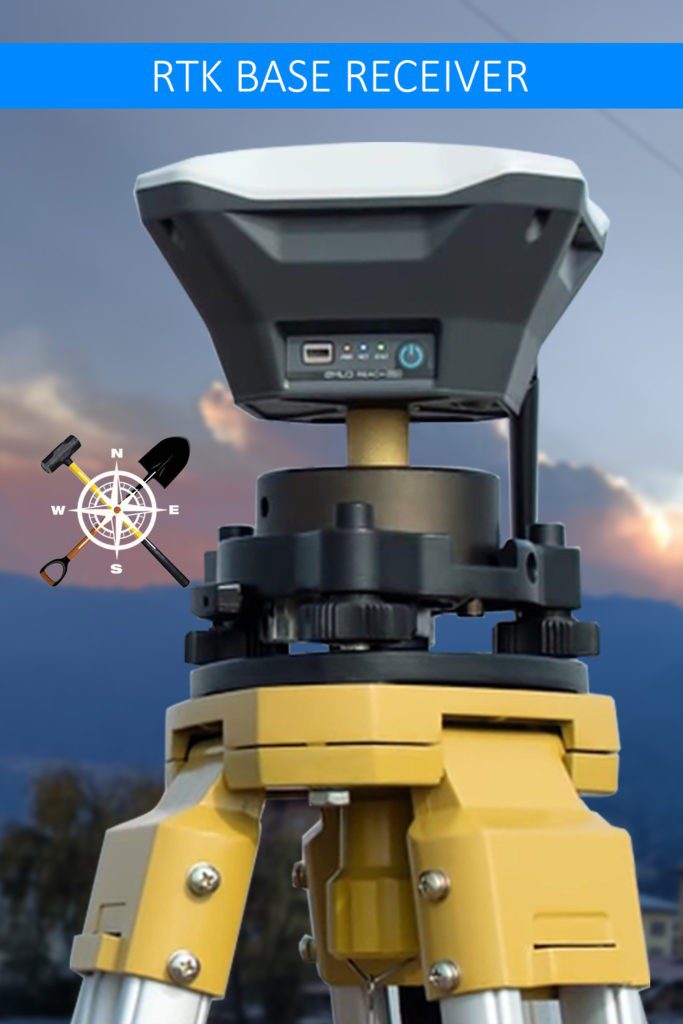
Base Station
One Receiver is stationed in a fixed position (coordinates) as a base station. The RTK base station transmits its raw observations to the rover(s) in real-time, and the rover uses both the rover and base observations to compute its position relative to the base.
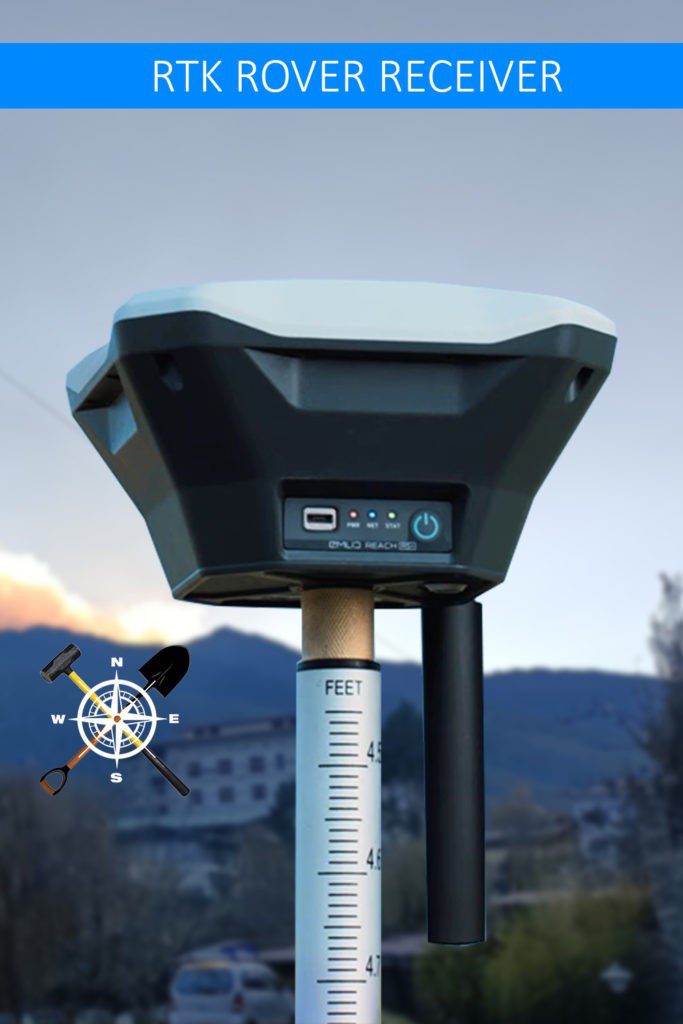
Rover Receiver
After a short initialisation time (often less than a minute), the rover can continuously determine a precise 3D vector relative to the base station. This type of surveying requires a reliable communication link between the base and the rover, as the rover needs continuous observations from the base.
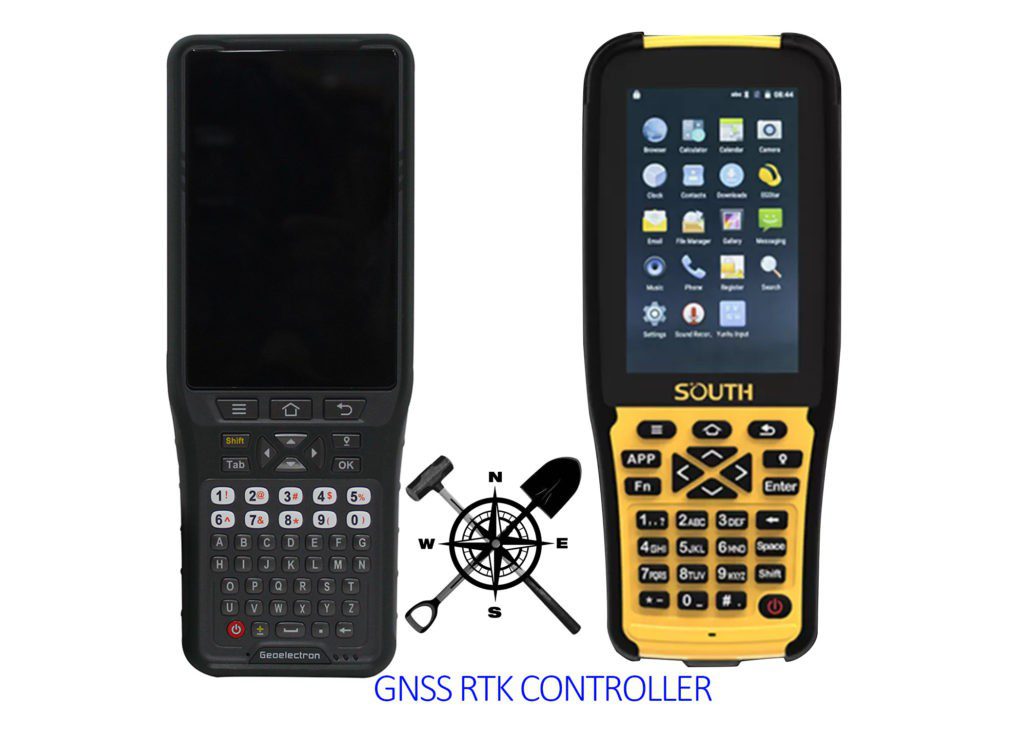
Controller
A device that comes with a touchscreen or keypad, which has a similar look to a smartphone and is powered by a Windows or Android application. This controller is used to collect the computed and corrected data from the rover. The controller is connected to the rover through Bluetooth. The rover and Base station are connected to the radio.
Types of Receivers of GNSS
In general, there are two types of receivers based on bands: single and multiple bands. A single-band receiver is designed to receive only one frequency band from the satellites. Whereas the multi-band receiver works with several frequency bands. The number of frequency bands does not affect the accuracy. Each satellite constantly transmits single or multiple bands.
Comparisons between Single and Multi-Band Receivers
Point of Differences
- Multi-band achieves a fixed solution within seconds and maintains robust performance even if the sky view is partially blocked. Whereas it takes up to several minutes for a single-band receiver to get the fixed solution when you start to work.
- Multi-band receivers can work on longer baselines, up to 60km in real-time kinematics and 100km in Post Processed kinematics (PPK). For a single-band receiver, it works on a relatively shorter baseline up to 10km in RTK and 30km in PPK.
- A single band is ideally suitable for an open environment, and a multi-band is suitable for working in tough conditions.
- A single-band receiver receives an optimal and affordable signal compared to a Multi-band receiver.
Point of Similarities
- Both single and multi-band receivers have the same level of accuracy.
- Both types of devices can achieve fixed solutions.
- They can achieve centimetre accuracy when working with precise point positioning services
How GNSS RTK Surveying Works
GNSS RTK (Real-Time Kinematic) surveying works by using satellite signals and real-time corrections to achieve centimeter-level positioning accuracy. The system relies on two main components: a base station and a rover receiver. Step-by-Step Working Process is explained below:
1. Satellite Signal Reception
Multiple GNSS satellites (GPS, GLONASS, Galileo, BeiDou) continuously transmit signals to receivers on Earth. Both the base station and rover receive these signals simultaneously.
2. Base Station Setup (Known Position)
The base station is placed at a point with known coordinates.
- It calculates the difference between its known position and the position calculated from satellite signals.
- This difference represents the error in satellite data.
3. Error Correction Calculation
The base station determines errors caused by:
- Atmospheric delays
- Satellite clock errors
- Orbital inaccuracies
★ Important Note: These corrections are crucial for achieving high precision.
4. Real-Time Data Transmission
The base station sends correction data to the rover via:
- Radio signals
- Internet (NTRIP / CORS network)
5. Rover Position Correction
The rover receiver:
- Receives satellite signals
- Applies correction data from the base
- Calculates its position with centimeter-level accuracy in real time
★ Important Note: RTK accuracy depends on clear sky visibility, stable correction signals, and proper receiver setup.
Applications of RTK Surveying in Construction
GNSS RTK surveying is widely used in the construction industry where high accuracy and real-time positioning are required. Some common applications include:
1. Construction Layout / Setting Out
Used to mark exact positions of buildings, columns, roads, drains, and utilities according to design drawings.
2. Topographic Surveys
Helps create accurate ground surface maps, contours, and site levels for planning and design.
3. Earthwork Measurement
Used to calculate cut and fill quantities, excavation volume, and grading progress.
4. Road and Highway Construction
Used for centerline alignment, curve setting, level checks, and pavement works.
6. Drone Mapping and Surveying
Many survey drones use RTK for accurate aerial mapping, orthomosaic images, and 3D models.
8. Utility and Pipeline Installation
Helps in accurate alignment of underground pipes, cables, and drainage systems.
9. Land Boundary Surveying
Used for precise boundary marking and land subdivision.
Advantages of RTK Surveying
RTK surveying is one of the fastest-growing methods of surveying and has many advantages over the traditional surveying method.
- Surveying with RTK is much faster and quicker. Therefore, saves a lot of time for other activities.
- Data collected is highly accurate up to a centimetre level. Because of this high precision, RTK technology is commonly integrated into drones for topographic mapping, land surveying, and progress monitoring on construction sites. Read more in our guide on drones in construction.
- The technology comes with powerful functionality that is capable of sticking and fixing points on the ground in real time.
Limitations or Disadvantages of RTK Surveying
As every coin has two sides, this method of surveying has some limitations too.
- They cannot be used in the marine or on land with obstructions (such as under buildings, trees, shaded areas, etc.).
- The base station needs to be guarded by a survey assistant to check the proper function of the machine, check the level of the battery and other human and animal interventions of the machine.
RTK vs Total Station Surveying
| Basis of Comparison | RTK Surveying | Total Station Surveying |
|---|---|---|
| Full Form | Real-Time Kinematic GNSS Surveying | Electronic Optical Survey Instrument |
| Working Principle | Uses satellite signals with correction data from base station/network | Uses laser/infrared beam with angle and distance measurement |
| Accuracy | Centimetre-level accuracy | Very high millimetre to centimetre accuracy |
| Line of Sight Required | No direct line of sight between points required | Yes, clear line of sight required |
| Speed of Survey | Faster for large open areas | Slower for large areas |
| Best Suitable Area | Large sites, roads, highways, land surveys | Buildings, detailed layout, congested sites |
| Setup Time | Quick setup | Requires instrument setup and target prism alignment |
| Manpower | Often one person can operate | Usually two persons preferred |
| Performance in Obstructed Areas | Reduced under trees, buildings, tunnels | Better where satellite signals are blocked |
| Range | Wide coverage using satellites | Limited by visibility and instrument range |
| Data Output | Real-time coordinates | Precise measured points and coordinates |
| Cost | Higher initial GNSS equipment cost | Moderate to high depending on model |
| Common Uses | Topographic survey, machine control, drone mapping | Building layout, column setting, detailed engineering works |
Recommended Reading:
Frequently Asked Questions
Q: Is RTK more accurate than GPS?
Answer: Yes, RTK is significantly more accurate than standard GPS.
Q: What is the range of RTK surveying?
Answer: Usually 10–20 km from base station depending on terrain and radio signal.
Q: Can drones use RTK?
Answer: Yes, many modern mapping drones use RTK.
Q: What accuracy does RTK provide?
Answer: Typically ±1 to 3 cm horizontal accuracy.
Q: Is RTK surveying better than total station?
Answer: RTK is faster and ideal for open areas, while a total station is better in congested or covered locations. Both are often used together in engineering projects.
Conclusion
RTK surveying is ideal for fast and large-scale outdoor surveys, while Total Station is better for high-precision detailed works and obstructed construction sites. In many projects, both instruments are used together for best results.
References
- Real-Time Kinematic (RTK). (n.d.). NovAtel. Retrieved October 8, 2022, from https://novatel.com/an-introduction-to-gnss/chapter-5-resolving-errors/real-time-kinematic-rtk
- Real-time kinematic positioning. (2022, June 5). In Wikipedia. https://en.wikipedia.org/wiki/Real-time_kinematic_positioning