


Last updated: 3 May 2026

Introduction
Masonry is a construction technique that involves bonding individual units such as stones, bricks, or concrete blocks using mortar. Among the various masonry units used in construction, when natural stones are used as the primary material, the process is known as stone masonry. Among its different types, rubble masonry is one of the most widely used due to its simplicity, durability, and cost-effectiveness.
This article focuses on the different types of stone masonry, with special emphasis on rubble masonry techniques, their characteristics, and applications.
Stone Masonry Work
Stone rubble masonry works are classified into two categories depending upon the arrangement of the stones in the construction, the degree of refinement used in shaping the stone and the finishing adopted.
- Rubble Masonry
- Ashlar Masonry
Materials for Stone Masonry Wall
The following two types of materials are used for stone masonry works: –
- Stone
- Mortar
Stone
In stone masonry, the principal material is stone, which may be dressed or undressed. It is essential that the stone chosen for masonry work is hard, durable, tough, and sound. The stone should be free from defects such as cavities, cracks, sand holes, injurious veins, and pitches of loose or soft materials. Additionally, it should be resistant to weathering and decay. Read our detailed guide on 12 Properties of Good Building Stones, and also on the guide of 10 Types of Stones Used for Construction Works.
Mortar
Mortar is a binding material used in masonry construction. It is typically made by mixing cement or lime with sand and water to create a uniform mixture. Therefore, either cement mortar or lime mortar is used. The choice of the mortar used depends on various factors, such as the type of mortar needed, the intended use and exposure of the structure, the expected load intensity, and the required durability and bond strength. Other special considerations may include requirements for fire resistance, rate of setting, and hardening.
Types of Stone Rubble Masonry
In this type, the stone blocks are undressed or comparatively roughly dressed. The masonry has wide joints since stones are of irregular size, and rubble masonry may be of the following types: –
- Random Masonry
- Square Masonry
- Miscellaneous Masonry
- Dry rubble Masonry
Random Masonry
In this category, the stone blocks are arranged randomly on the wall. Thus, the type of work is called Random Rubble Masonry (RRM) works. This type of wall is also classified into two categories.
- Un-coursed Random Rubble Masonry
- Coursed Random Rubble Masonry
Uncoursed Random Rubble Masonry
In this category, the stones are irregularly arranged and of different sizes. Due to the wide variety of stone sizes and shapes, great care and ingenuity have to be exercised in arranging them in such a way that they adequately distribute the pressure over the maximum area. At the same time, long continuous vertical joints are avoided.
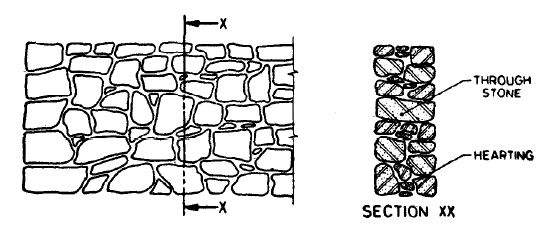
For proper construction of stone masonry, the bonding should be available both transversely and longitudinally. Transverse bonding is achieved by using headers liberally. Quoins and jambs are constructed using longer stones to enhance strength and improve appearance. This method of stone masonry is often considered the most cost-effective way of building a stone wall.

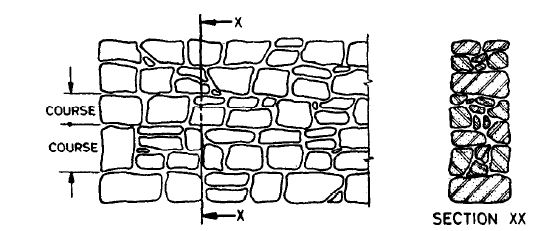
Courses Random Rubble Masonry
This method of construction is similar to uncursed random rubble masonry except that the work is roughly levelled up to form a course varying from 30 to 45 cm thick. All the courses are not of the same height. For the construction of such masonry, quoins are built first, and a line is stretched between the tops of the quoins.
The intervening walling is then brought up to this level by using different sizes of numbers in the order in which they are placed. This form of masonry is better than uncoursed random rubble masonry.
Square Rubble Masonry
Square rubble masonry uses stones with straight beds and sides. The stones are usually squared and brought to a hammer-dressed or straight-cut finish.
Uncoursed Square Rubble Masonry
In the course square rubble, also sometimes known as square snacked rubble, the stones with straight edges and sides are available in different sizes (height). They are arranged on the face in several irregular patterns, having their depth in the ratio of 3:2:1.
This prevents the occurrence of long continuous joints. Such a type of masonry is characterised by sneck and the name.
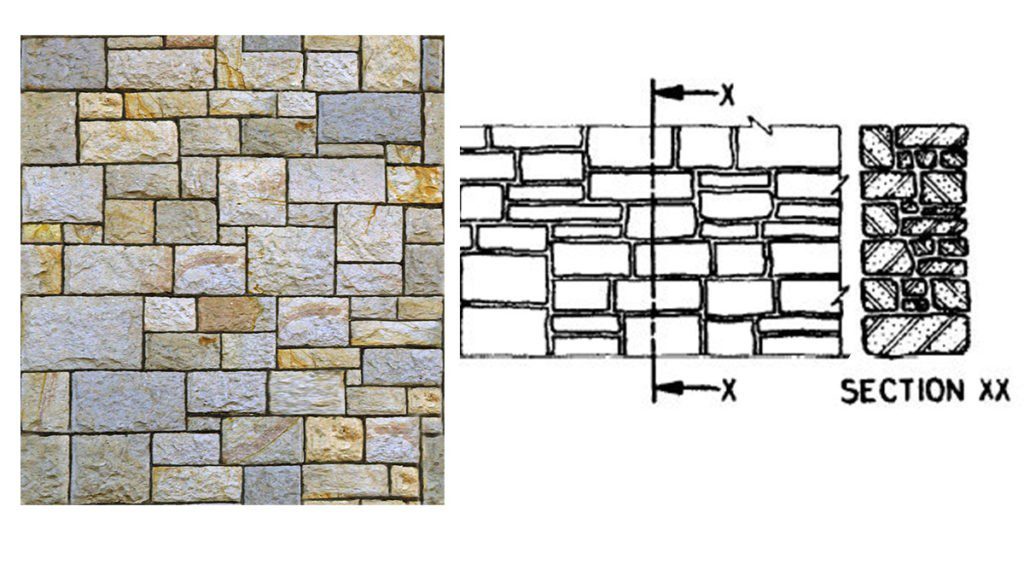
Course Square Rubble Masonry
This type of masonry uses the same stones as used in uncoursed square rubble, but the work is levelled up to courses of varying depth. The courses are of varying heights. Each course may consist of quoins, jamb stones, bonder and through stones of the same size with smaller stones built between them up to the height of the larger stones, to complete the course.

Regular Coursed Rubble Masonry
In this type of masonry, the wall consists of various courses of varying heights, but the stones in one particular course are the same height.

Miscellaneous Types of Masonry
In this category, the stone blocks are hammer-dressed and are of irregular shapes. The block’s width and thickness vary from 7.5 to 15cm. There are two types of arrangement of stone blocks in this category, and they are namely, polygonal rubble and flint rubble masonry.
Polygonal Rubble Masonry
In this type, the stones are hammer-dressed on the face to an irregular polygonal shape. These stones are bedded in position to show face joints running irregularly in all directions. There may be two types of polygonal rubble masonry walls.
In the first type, stones are only roughly shaped, resulting in only rough fitting. Such work is known as rough-picked. Whereas, in the second type, the face of the stones is more carefully formed so that they fit more closely. Such work is known as close-picked work.
Flint Rubble Masonry
The stones used in this type of masonry are flints or cobbles, which vary in width and thickness from 7.5 to 15cm and in length from 15 to 30 cm. These are irregularly shaped nodules of silica. The stones are extremely hard, but they are brittle and may break easily.
The face arrangement of cobbles may be either coursed or uncoursed or built to courses. The strength of the flint wall may be increased by introducing lacing courses of either thin long stones or bricks at vertical intervals of 1 to 2 metres.
Dry Rubble Masonry
Dry rubble masonry is made to the course in which mortar is not used in the joints. This type of construction is the cheapest and requires more skill in construction. This may be used for non-load-bearing walls, such as compound walls.
Frequently Asked Questions
Q: What are the different types of stone masonry?
Answer: The stone masonry works are broadly classified into two categories:
1. Rubble Masonry
2. Ashlar Masonry
3. Polygonal Masonry.
Q: What is the classification of Ashlar masonry works?
Answer: Ashlar masonry works are of the following types:
1. Ashlar fine tooled
2. Ashlar rough tooled
3. Ashlar rock, rustic or quarry faced
4. Ashlar chamfered
5. Ashlar block in the course
6. Ashlar facing
Q: What types of stones can be used for stone masonry work?
Answer: A variety of stones can be used, including granite, limestone, sandstone, and marble.
Q: What are the advantages of stone masonry?
Answer: Stone masonry is known for its durability, strength, and aesthetic appeal. It can also provide excellent insulation and soundproofing.
References & Standards
- Ching, F. D. K. (2020). Building construction illustrated (6th ed.). John Wiley & Sons, Inc.
- Duggal, S.K.(2008). Building Materials. New Age International (P) Limited, Publishers
- Bureau of Indian Standards. (1987). IS 1905: Code of practice for structural use of unreinforced masonry.
- Bureau of Indian Standards. (1981). IS 2250: Code of practice for preparation and use of masonry mortars.


