



Last updated: 27 April 2026

Fresh concrete achieves its desired strength over time through proper curing. Curing is essential for maintaining adequate moisture and a favourable temperature, which allows the hydration process to continue effectively and ensures proper strength development.
By implementing effective curing practices, such as consistent moisture retention and temperature control, concrete gradually gains strength as the chemical reactions progress. Without proper curing, the concrete may suffer from reduced strength, surface cracking, and durability issues.
This article explores the importance of concrete curing in construction and discusses various methods and best practices to achieve effective and long-lasting results.
What is Concrete Curing?
Concrete curing is the process of maintaining adequate moisture and temperature in concrete to ensure proper hydration of cement. This process allows the concrete to gain strength, durability, and long-term performance. It is an essential topic in Concrete Technology for quality construction.
In simple terms, curing helps retain water within the concrete, enabling the ongoing chemical reaction (hydration) between cement and water. Without proper curing, concrete may lose moisture too quickly, leading to reduced strength and surface cracking.
This process is crucial because concrete releases heat during the initial setting and hardening stages, and uncontrolled conditions can negatively affect its quality and structural integrity.
Effect of Curing
Strength Development:
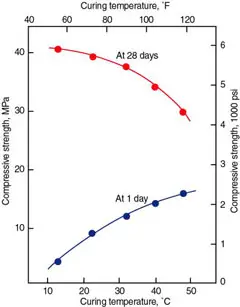
The primary objective of curing is to ensure proper strength development of concrete. Curing plays a critical role in the hardening process by maintaining the required moisture and temperature conditions for continuous hydration.
During hardening, concrete releases a significant amount of heat, which can lead to moisture loss and incomplete hydration if not properly controlled. By adopting effective curing methods, this moisture loss is minimised, allowing the concrete to achieve its intended strength and structural performance.
In addition to enhancing strength, proper curing also helps in reducing permeability, thereby improving the durability of concrete (Mehta, p. 442).
Optimisation of Temperature:
Due to the hydration of cement, concrete generates a significant amount of heat, which can raise its temperature by up to 20 °C. This increase in temperature may accelerate moisture loss and affect the quality of the hardened concrete. Therefore, it is important to optimise the cement content to control heat generation, especially in large pours.
The ideal ambient temperature for concreting ranges between 10 °C and 24 °C, and these conditions should be maintained throughout the curing period to ensure proper hydration and strength development (Chudley & Greeno, p. 240).
Water Retention
Curing plays a vital role in maintaining moisture within the concrete, which is essential for proper hydration. During the hydration of cement, water can be lost due to evaporation, especially under hot or windy conditions.
By applying curing methods such as surface watering or covering, moisture loss is minimised, allowing the concrete to retain sufficient water for continuous hydration. This helps in achieving optimal strength, durability, and reduced cracking.
For concrete made with Ordinary Portland Cement (OPC), it is recommended to keep the surface moist for at least 7 days to ensure effective curing.
Water as a Curing Material
Water is the most commonly used curing material for concrete due to its effectiveness and ease of application. It is typically applied by methods such as ponding, sprinkling, or spraying (mist/steam curing in some cases) to maintain adequate surface moisture.
According to ACI 308.1-11, “Water used for curing shall be free of materials that have the potential to stain concrete or are known to cause deterioration of concrete or reinforcing steel.” This highlights the importance of using clean and non-aggressive water during the curing process.
In practice, the same quality of water used for mixing concrete is also suitable for curing. Such water should be free from harmful substances such as organic matter, acids, alkalis, oils, and salts, which could adversely affect the concrete properties. This recommendation is also supported by IS 456: 2000.
Duration for Curing
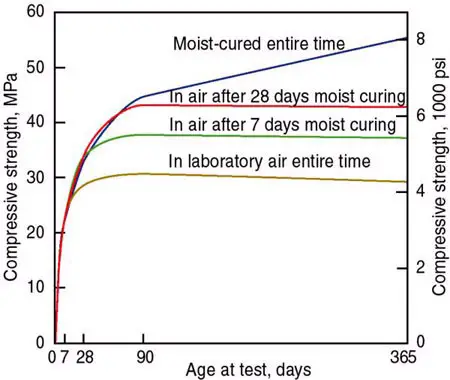
The duration of curing depends on several factors, including the quality of concrete, the type of cement, and the environmental conditions in which the concrete is placed.
In general, concrete elements such as ground slabs (floors, pavements, sidewalks, parking areas, driveways, and canal linings) and structural members like columns, beams, slabs, bridge decks, piers, footings, and retaining walls require a minimum curing period of 7 days under normal ambient conditions with temperatures above 5°C.
Proper curing duration is essential to ensure adequate strength development, durability, and resistance to cracking.
The duration of curing mainly depends on the following factors:
- Future exposure conditions (aggressive environment, load conditions, etc.)
- Strength requirement of the concrete
- Concrete mix proportion (water-cement ratio, cement type, etc.)
- Size and shape of the concrete member
- Ambient weather conditions (temperature, humidity, wind)
American Concrete Institute (ACI) 301 recommends a minimum curing period corresponding to concrete attaining 70 per cent of the specified compressive strength. 7 days are recommended to achieve 70 per cent of the compressive strength of concrete.
Also, as per IS 456-2000, the concrete should not be cured for less than 7 days. The minimum duration is given in the table below as per the IS 456-2000 for different materials used for preparing concrete.
| Basic | Minimum days for curing |
| OPC | 7days |
| Blended Concrete | 10days |
| Mineral admixture added. Read more in our detailed guide on Concrete Admixtures. | 14days |
| Hot and dry condition | 10days |
Read Also: What is The Water-Cement Ratio?: Calculation and Value of Water Cement Ratio.
Different Methods of Curing
Water curing, membrane curing, steam curing, and chemical curing are common methods used in modern Concrete Technology practices. Different methods are adopted at the site depending upon the structural member or concrete components. These methods are as follows:-
- Water Curing
- Membrane Curing/ Compound Curing
- Steam curing
Water Curing
Water curing involves applying water to the surface of freshly laid concrete for a certain period of time after it has hardened. This method helps in maintaining the concrete’s moisture content and supporting proper hydration, promoting optimal strength development. Water curing is done in three ways:
- Ponding
- Spraying
- Wet Covering
Ponding
Ponding is a widely used curing method for horizontal, flat concrete surfaces, where it is possible to retain a layer of water on the surface.
In this technique, a temporary perimeter barrier made of mortar or clay (approximately 25–50 mm high) is constructed around the concrete surface to hold water. The enclosed area is then filled with water, forming a shallow pond over the concrete.
This method ensures continuous water contact, maintaining adequate moisture for hydration and preventing evaporation. As a result, the concrete achieves uniform strength development, improved durability, and reduced surface cracking.
Ponding is most commonly used for curing slabs, floors, pavements, and other horizontal surface elements.
Spraying (Fogging)
Spraying, also known as fogging, is a curing method used when ponding is not feasible, particularly on vertical or inclined concrete surfaces.
In this technique, a fine mist of water is continuously applied to the concrete surface to maintain adequate moisture. This creates a thin film of water that helps prevent moisture loss and supports ongoing hydration of cement.
Unlike heavy water application, spraying ensures uniform moisture distribution without damaging the surface, making it especially suitable during the early stages of curing. It helps the concrete achieve improved strength, durability, and resistance to cracking.
This method is commonly used for curing plastered surfaces, walls, columns, beams, and other vertical members, where conventional methods like ponding cannot be applied effectively.
Wet Covering
Wet covering is a widely used curing method applicable to both vertical and horizontal concrete surfaces. In this technique, moist materials such as burlap, gunny bags, or fabric sheets are placed over the concrete surface to retain moisture during the curing period.
These coverings are kept continuously wet, which helps prevent moisture loss, ensures proper hydration of cement, and promotes uniform strength development in the concrete.
Wet covering is particularly effective in situations where ponding or continuous water spraying is not practical. It is commonly used for curing vertical members such as columns and walls, as well as horizontal surfaces like slabs and pavements.

Membrane Curing (Compound Curing)
Membrane curing, also known as compound curing, is a method in which a membrane-forming compound or sheet is applied to the surface of freshly placed concrete to prevent moisture loss.
The primary purpose of this method is to create a barrier that reduces evaporation, allowing the concrete to retain sufficient moisture for proper hydration and strength development.
Typically, the curing compound is sprayed or rolled onto the concrete surface, forming a thin, continuous film. Alternatively, pre-formed membrane sheets (such as plastic sheets) can be placed directly over the surface. This membrane acts as a protective layer, sealing the concrete and minimising water loss.
Curing compounds generally consist of materials that form an impermeable or semi-permeable film, effectively retaining moisture within the concrete. (Note: calcium chloride is not commonly used as a membrane-forming curing compound and should not be cited as a standard practice in this context.)
It is important to note that curing compounds should be avoided when subsequent surface treatments are required, such as plastering, tiling, or coatings that depend on proper bonding. However, this method is widely used in pavements, highways, and bridge decks, where continuous water curing is not practical.

Read Also: Compressive Strength of Concrete
Steam Curing
In the production of precast (prefabricated) concrete units, steam curing is commonly used to accelerate the strength development process. In this method, steam is applied to concrete elements placed inside enclosed chambers, providing controlled temperature and moisture conditions.
The use of steam significantly reduces the curing time by speeding up the hydration of cement, making it especially suitable for precast industries where early strength gain and faster production cycles are required.
There are two main types of steam curing:
- Low-pressure steam curing (at atmospheric pressure)
- High-pressure steam curing (autoclaving)
Read Also: Concrete Laitance | Definition | Cause | Remedy
Frequently Asked Questions
Q: Why is concrete curing important?
Answer: Concrete curing is important as it helps prevent the loss of water from the freshly laid concrete during the hydration of the cement. During the hydration of the cement, there is a rise in temperature that generates a significant amount of heat, possibly up to 20 °C. Thus, curing helps to retain the water or moisture in the concrete so as to achieve strength and prevent possible shrinkage cracks in the future.
Q: When to start concrete curing?
Answer: Curing on construction sites commences immediately after the concrete has completely set, typically around 12 to 24 hours after placement. It is crucial to initiate curing during the early stages of hardening, and it should be sustained for an extended period, ideally lasting at least 7 days for the use of Ordinary Portland Cement.
Q: How long should concrete be cured?
Answer: According to the American Concrete Institute (ACI) 301 guidelines, it is recommended to have a minimum curing period that aligns with the concrete reaching 70 per cent of its specified compressive strength. To achieve this level of strength, a curing duration of 7 days is advised.
References & Standards
- Greeno, R. & Chudley, R. (2014). Building Construction Handbook. Routledge. 2 Park Square, Milton Park, Abingdon, Oxon, OX14 4RN
- Mehta, M., Scarborough, W., & Armpriest, D. (2017). Building constructions: Principles, materials, and systems. Pearson Education, Inc.
- ACI SPEC-301-16 Specifications for Structural Concrete. (n.d.). https://www.concrete.org/store/productdetail.aspx?ItemID=301U16&Language=English&Units=US_Units
- Indian Standard. (2000). Plain and reinforced concrete – code of practice (IS 456:2000). Bureau of Indian Standards.
- The Constructor. (2020, July 24). What is membrane curing of concrete? – The Constructor. https://theconstructor.org/question/what-is-membrane-curing-of-concrete/
- Johnson, W. (2022, March 23). Do You Need to Keep Concrete Wet During the Curing Process? Concreteily. https://concreteily.com/concrete-wet-during-the-curing-process/
- Lead, C. (2021, November 7). What is Curing of Concrete?- Purpose, Importance, Curing Period & Methods – Civil Lead. Civil Lead. https://www.civillead.com/curing-of-concrete/


