
Last updated: 27 April 2026

Concrete can be placed, compacted, and finished using different methods depending on the type of structure, site conditions, and accessibility of the work area. In modern Concrete Technology, specialized placement techniques are used to improve efficiency, bonding, and construction speed where conventional casting becomes difficult. One such advanced method is shotcrete, in which concrete or mortar is pneumatically projected onto a prepared surface at high velocity through a hose and nozzle.
Due to its excellent adhesion, dense compaction, and reduced need for formwork, shotcrete is widely used in tunnels, retaining walls, swimming pools, slope stabilization, underground works, and repair of damaged concrete structures. Depending on project requirements, it may be applied by the dry-mix or wet-mix process. In this article, we discuss the definition, process, types, uses, advantages, and limitations of shotcrete in construction.
What is Shotcrete?
Shotcrete is a technique of applying cement mortar or concrete at high speed onto the prepared vertical or overhead surface, which is conveyed through a hose attached to a nozzle at the end. It is also known as sprayed concrete, and the process involves using a pneumatic machine to mix and spray the concrete or mortar onto a surface at high speeds, resulting in a durable and high-strength finish.
The process involves the application of pressurised concrete to a vertical and overhead surface using a nozzle. Shotcrete is commonly used in construction projects such as building tunnels, swimming pools, retaining walls, and bridges. It is a popular method because it allows for quick and efficient application of concrete, reducing construction time and labour costs.
Types of Shotcrete Processes
Shotcrete is mainly applied by two methods: the wet-mix process and the dry-mix process. Both methods are widely used in modern Concrete Technology, depending on project size, site conditions, equipment availability, and required output.
In the wet-mix process, cement, aggregates, water, and admixtures are fully mixed before entering the delivery hose. The prepared concrete is then pumped to the nozzle and pneumatically projected onto the surface at high velocity. This method offers better quality control, higher production capacity, reduced dust generation, and is commonly preferred for large construction works such as tunnels, retaining walls, and structural linings.
In the dry-mix process, cement, sand, and aggregates are first mixed in dry conditions and conveyed through the hose using compressed air. Water is added only at the nozzle immediately before spraying onto the prepared surface. This method is useful for repair works, smaller projects, and locations where intermittent application is required. The dry-mix process is traditionally known as Gunite.
Comparison of dry-mix and wet-mix processes
The comparison made between dry-mix and wet-mix processes is in accordance with ACI 506R-4. Either process is suitable for normal construction requirements. The differences lie in the capital and maintenance costs of equipment, operational features, the suitability of available aggregate, and placement characteristics. However, one or the other may be more attractive for a particular application.
| Dry-mix process | Wet-mix process |
|---|---|
| 1. Instantaneous control over mixing water and consistency of the mixture at the nozzle to meet variable field conditions. | 1. Mixing water is controlled by mixing equipment and can be accurately measured. |
| 2. Better suited for placing mixtures containing lightweight aggregates or refractory materials. | 2. Better assurance that the mixing water is thoroughly mixed with other ingredients. |
| 3. Capable of being transported long distances. | 3. Less dust and cementitious materials were lost during the shooting operation. |
| 4. Delivery hoses are easier to move. | 4. Normally has a lower rebound, resulting in less waste. |
| 5. Lower volume per hose size. | 5. Higher volume per hose size. |
Also, read: What is Mass Concrete?
Advantages
The process has a variety of advantages over conventional concrete for new construction and repair works. Some of the advantages are as listed below:
- Makes the structure less porous, which increases the bond strength of the concrete.
- Lower the construction time and reduce the costs of the construction.
- For protecting channel linings, bridge safety, and stabilising debris flows.
- Used for the restoration of deteriorating marine constructions such as bulkheads, piers, seawalls, and so on.
Disadvantages
- The process is expensive compared to conventional concrete.
- There is so much waste of concrete.
- Dust is a problem with the technique.
Also, read: What is Ready Mix Concrete? | Types of Ready Mix Concrete
Applications
Shotcrete can be used instead of conventional concrete in many instances; the choice is based on convenience and cost. The process has advantages over conventional concrete in a variety of ways for new construction and repair work as well. Some of the advantages are listed below.
- Restoration and Repairing Works
The shotcrete is suitable for restoration works for damages caused to the concrete structure due to natural disasters such as fire, earthquake, etc. It is also applicable for repairing worn-out concrete from the old structure, such as the surface and soffits of bridges, culverts, walls and many more.
- Slope stabilization or Surface protection
Sometimes it is chosen to protect the slope, which is not stable and could fall apart at any time. Therefore, the surface of the slope is protected by applying concrete, which uses the process of shotcrete. This concrete protects the unstable surface of the ground and the rock from erosion and runoff during heavy showers.
- Pools and Tanks
Due to the complex geometry of the pool chosen by the client, it is difficult to make mould or formwork for the concrete work. The work also becomes labour-intensive and has an uneven surface finish. Thus, this work is easily carried out by applying shotcrete for the complex geometry pool and water tank construction.

- Complex Structure Construction
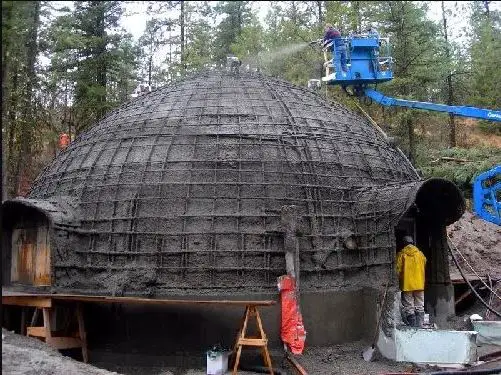
The technique is easily applicable for the ease of work for complex structures, such as dome-shaped houses and complex architectural shapes.
Also, read: What is Plum Concrete?
Frequently Asked Questions
Q: What Is Shotcrete?
Ans: As per ACI, concrete terminology, shotcrete is defined as “concrete placed by a high-velocity pneumatic projection from a nozzle.”
Q: How is shotcrete different from conventional concrete?
Ans: Conventional concrete is usually delivered to construction sites via ready-mix trucks, placed in the forms, and then vibrated for compaction. On the contrary, shotcrete does not require forming or compaction, which increases application flexibility and creativity, also reducing the labour intensity.
Q: What are the types of shotcrete processes?
Ans: According to ACI 506R, the shotcrete process is of two types, namely,
1. Dry-mix process (gunite) and
2. Wet-mix process


