
Last updated: 23 September 2026

Asphalt pavement is widely used in road construction because of its durability, cost-effectiveness, and ease of maintenance. Over time, however, it can develop cracks and other defects that may worsen if left untreated. Recognising the signs of deterioration, identifying their causes, and selecting suitable repairs are essential for maintaining safe and serviceable roads.
This article explains 12 common types of asphalt pavement defects, including cracking, potholes, depressions, and ravelling, along with their symptoms, underlying causes, and repair methods.
What Is an Asphalt Pavement Defect?
An asphalt pavement defect is damage or deterioration that affects the pavement’s surface condition, structural strength, or performance. Common examples include cracks, potholes, rutting, depressions, and ravelling. These defects may result from traffic loads, ageing, weather exposure, poor drainage, unsuitable materials, or construction deficiencies.
The severity of a defect depends on its cause, extent, and stage of development. Effective repair requires identifying and addressing the underlying problem, as treating only the visible damage may allow the defect to recur.
Types of Asphalt Pavement Defects
Asphalt pavement defects can be grouped into cracking, surface deformation, and disintegration. Cracking involves fractures in the pavement, deformation changes its shape or level, and disintegration involves the loss of pavement material.
Common types of asphalt pavement defects include:
- Alligator cracking (fatigue cracking)
- Block cracking
- Longitudinal cracking
- Transverse cracking
- Edge cracking
- Reflective cracking
- Slippage cracking
- Potholes
- Depressions (bird baths)
- Corrugation and shoving
- Upheaval
- Ravelling
Each defect has characteristic signs and underlying causes that help determine the appropriate repair method.
Alligator Cracking
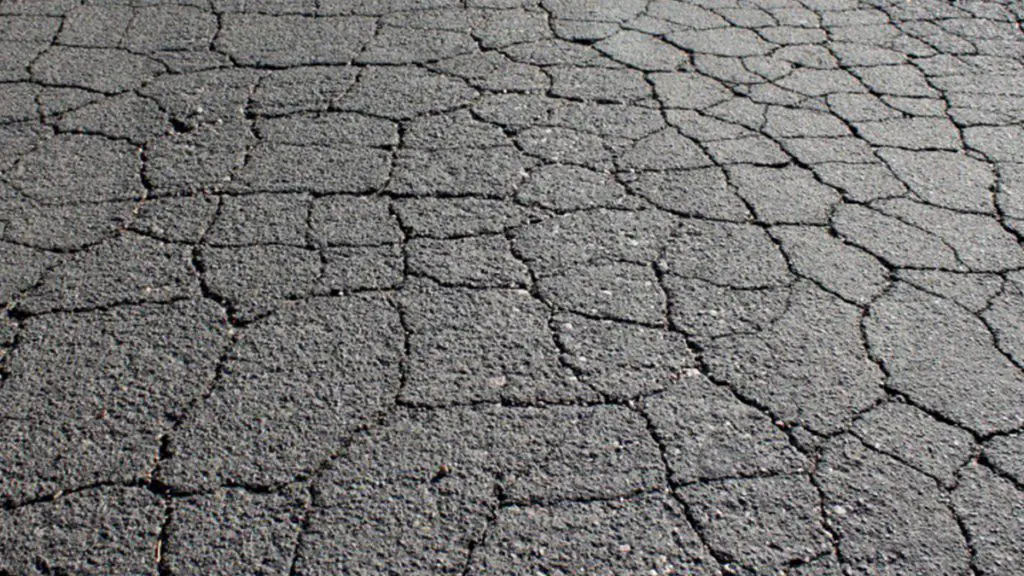
The type of crack observed in asphalt, which resembles the skin or back of an alligator, is commonly referred to as “alligator crack” or “crocodile cracking.” This name is derived from its resemblance to the pattern found on alligator skin. Alligator crack is characterised by interconnected cracks that form a series of small blocks on the surface of the asphalt pavement.
Causes
Alligator cracks occur as a result of one or more of the following factors:
- Excessive deflection of the pavement surface, particularly in the wheel tracks, is caused by an unstable subgrade, sub-base, or base of the pavement. Saturation of the subgrade or lower layers of the pavement can contribute to unstable conditions.
- Due to excessive loads imposed by heavy vehicles on the pavement surface, insufficient pavement thickness, or a combination of both factors.
- Binder brittleness can be attributed to either binder ageing or initial overheating. This brittleness can lead to the formation of fine cracks resembling the pattern on alligator skin. However, in such cases, there is no surface deflection. These cracks are sometimes referred to as “crazing.”
Repairing
Alligator cracking is due to a structural failure, and the only possible solution to alligator cracking is to perform a full-depth patch.
Block Cracking
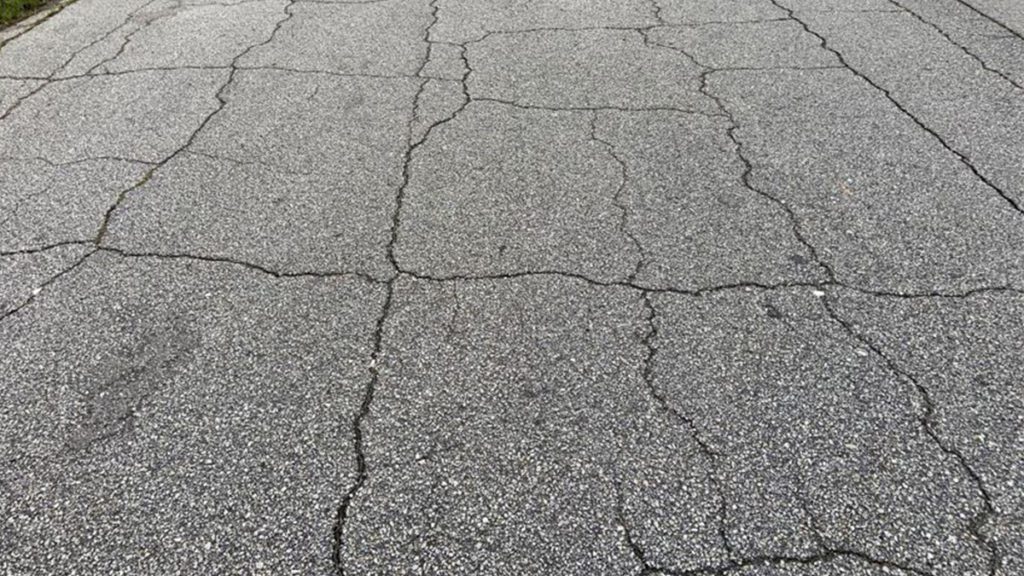
One of the asphalt pavement defects is block cracking is the formation of cracks on the pavement in a rectangular pattern in either direction of the flow of traffic.
Causing
This crack is caused by shrinkage of the asphalt pavement due to the inability of asphalt to expand with the changing temperature. This can be because the mix was mixed and placed too dry; fine aggregate mix with low penetration asphalts and absorption aggregate; poor choice of asphalt binder in the mix design; or ageing, dried-out asphalt.
Repairing
Cracks in asphalt with less severe measuring up to 1/2 inch or less can be sealed to prevent moisture from entering the subgrade. More severe cracks should be fixed by removing the cracked pavement layer and replacing it with an overlay.
Longitudinal Cracking
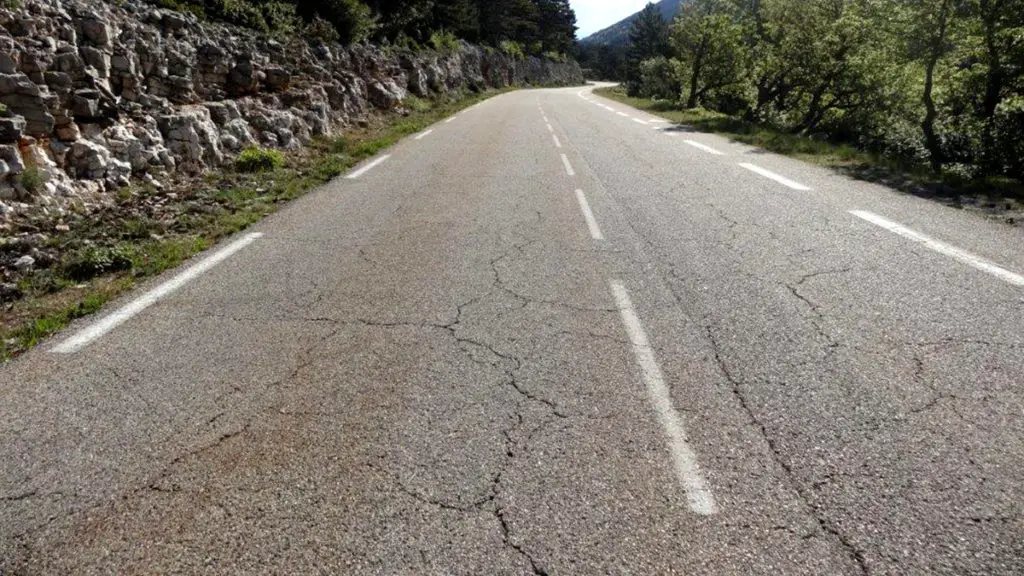
Longitudinal cracking refers to cracks that form in a straight line along the road, running parallel to the pavement’s centerline or the direction of its construction. These cracks can manifest either at the joint between the pavement and the shoulder or at the joint between two adjacent paving lanes.
Cause
Longitudinal cracking can be the result of:
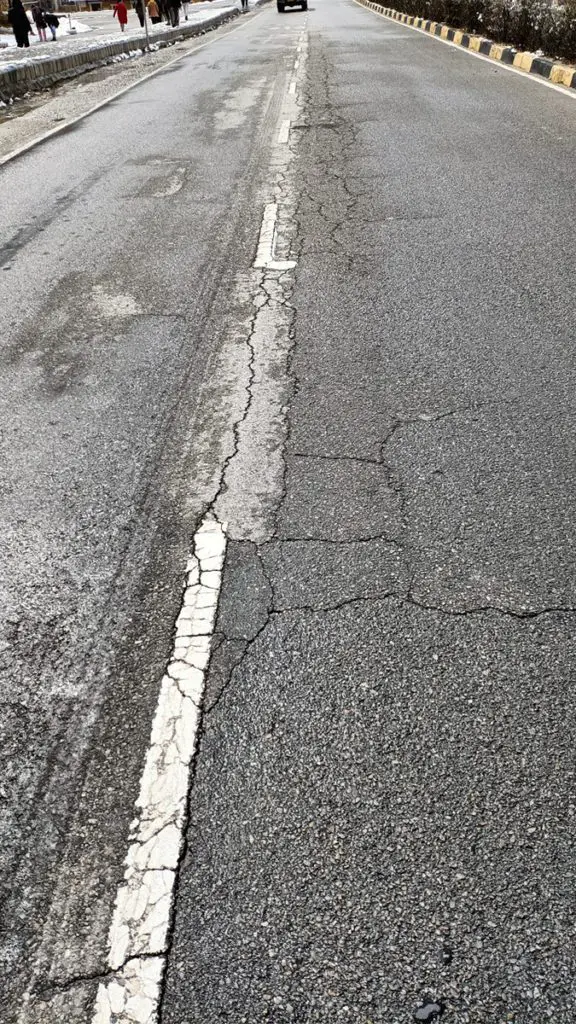
- These cracks in asphalt can be the result of pavement fatigue, reflective cracking, and/or poor joint construction. Joints are generally the least dense areas of pavement.
- The cracking at the pavement shoulder joint may be due to cyclic wetting and drying beneath the shoulder surface owing to poor drainage or due to depressions in the pavement edge which allow water to stand and seep through the joint. Another contributing factor can be shoulder settlement or the passage of trucks over the joint, which can generate stress and ultimately lead to the formation of these cracks.
Repair
Less severe cracks measuring 1/2 inch or less can be sealed to prevent moisture from entering the subgrade. More severe cracks should be fixed by removing the cracked pavement layer and replacing it with an overlay.
Transverse Cracking
Transverse cracks are single cracks perpendicular to the pavement’s centerline or layout direction.

Causes
Transverse cracks can be caused by reflective cracks from an underlying layer, daily temperature cycles, and poor construction due to improper operation of the paver.
Repair
Less severe cracks measuring 1/2 inch or less can be sealed to prevent moisture from entering the subgrade. More severe cracks should be fixed by removing the cracked pavement layer and replacing it with an overlay.
Edge Cracks
Edge cracks travel along the inside edge of the pavement surface within one or two feet.

Causes
This type of crack in asphalt pavement is the most common cause of this type of crack in poor drainage conditions and lack of support at the pavement edge. As a result, underlying base materials settle and become weakened. Heavy vegetation along the pavement edge and heavy traffic can also be the instigators of edge cracking.
Repair
The first step in correcting the problem is to remove any existing vegetation close to the edge of the pavement and fix any drainage problems. Crack seal /fill the cracks to prevent further deterioration, or remove and reconstruct to full depth, fixing any support issues.
Reflection Cracks
These are cracks in a flexible pavement overlay of a rigid pavement (i.e., asphalt over concrete). They occur directly over the underlying rigid pavement joints.

Cause
Joint reflection cracking does not include reflection cracks that occur away from an underlying joint or from any other type of base (e.g., cement or lime stabilisation).
Repair
For less severe cracks (less than 1/2 inch) crack sealing will prevent the further entry of moisture into the subgrade. If the cracks are more severe the removal of the cracked pavement layer followed by an overlay may be required.
Also, read: Traffic Islands: Types and Functionality
Slippage Cracks
Slippage cracks are crescent-shaped cracks or tears in the surface layer(s) of asphalt where the new material has slipped over the underlying course.

Cause
This problem can result from poor bonding between asphalt layers or inadequate adhesion between the asphalt and the underlying granular base. Contributing factors include insufficient or improperly applied tack coat, omission of a prime coat where specified, and dirt, oil or other contaminants that interfere with adhesion. For a detailed explanation of their roles and applications, read our article on Prime Coat vs Tack Coat in Road Construction.
Repair
All of the areas exhibiting the “stretch marks” will need to be removed and will require a partial or full-depth patch.
Potholes
Small bowl-shaped depressions in the pavement surface penetrate all the way through the asphalt layer down to the base course. They generally have sharp edges and vertical sides near the top of the hole.

Cause
Potholes are the result of moisture infiltration and are usually the result of untreated alligator cracking. As alligator cracking becomes severe, the interconnected cracks create small chunks of pavement, which can be dislodged as vehicles drive over them. The remaining hole after the pavement chunk is dislodged is called a pothole.
Repair
Full-depth replacement patch.
Depressions (bird baths)
Depressions are localised pavement surfaces with slightly lower elevations than the surrounding pavement. Depressions are very noticeable after rain when they fill with water.

Repair
Depending on the severity of the depression, the asphalt may have to be removed and replaced (severe ones). Less severe depressions can be fixed by applying a thin surface patch or infrared patch.
Corrugation and Shoving
A form of plastic movement typified by ripples (corrugation) or an abrupt wave (shoving) across the pavement surface. The distortion is perpendicular to the traffic direction. Usually occurs at points where traffic starts and stops (corrugation) or areas where HMA abuts a rigid object (shoving).
Causes
Is usually caused by traffic action (starting and stopping) combined with
- An unstable (i.e. low stiffness) HMA layer (caused by mix contamination, poor mix design, poor HMA manufacturing, or lack of aeration of liquid asphalt emulsions)
- Excessive moisture in the subgrade
Repair
A heavily corrugated or shoved pavement should be investigated to determine the root causes of failure. Repair strategies generally fall into one of two categories
- Small, localised areas of corrugation or shoving. Remove the distorted pavement and patch.
- Large corrugated or shaved areas are indicative of general HMA failure. Remove the damaged pavement overlay.
Also, read: Embankment Construction: Materials and Specification
Upheaval Cracks
The type of defect in the asphalt is due to the uplift of the subgrade of the pavement, which is common in the area where the frosting and swelling of the soil is a common issue. Upheaval is a localised upward movement in the pavement due to swelling of the subgrade.
Cause
Due to swelling of the subgrade from moisture or frost heave (ice under the pavement).
Repair
As this is the issue with the asphalt upheaval stem in the pavement subgrade, treatments like a crack seal and seal coating are not sufficient and are not recommended. Therefore, the best way to repair upheaval is to dig out the affected area of the pavement and base and then replace it with a full patch.
Ravelling (very porous asphalt)
Ravelling is the ongoing separation of aggregate particles in a pavement from the surface downward or from the edges inward. Usually, the fine aggregate wears away first and then leaves little “pockmarks” on the pavement surface. As the erosion continues, large and larger particles are broken free, and the pavement soon has a rough and jagged appearance typical of surface erosion. There are many reasons why ravelling can occur, but one common cause is placing asphalt too late in the season. This is because the mixture usually lacks warm-weather traffic, which reduces pavement surface voids, further densification, and kneading of the asphalt mat. For this reason, ravelling is more common in the more northern regions (snow belt).

Repair
Apply a thin hot-mix overlay. Other solutions could include sand seal, chip seal, slurry seal or micro-surfacing.
Also, read: Joints in Concrete Pavements: Transverse Joints & longitudinal joints
FAQs
Q. What causes cracks in asphalt pavement?
Answer: Asphalt pavement can crack because of repeated traffic loads, temperature changes, ageing binder, poor construction or weak underlying layers. Poor drainage can worsen the problem by allowing water to weaken the pavement’s support. The crack pattern and its location help identify the likely cause.
Q. How can you identify different types of asphalt cracks?
Answer: Longitudinal cracks run parallel to the road’s centreline, while transverse cracks run across it. Alligator cracks form small interconnected shapes, usually in wheel paths. Block cracks form larger rectangular patterns, and edge cracks develop near the pavement edge. Identifying the pattern is the first step in selecting a suitable repair.
Q. Can you put a new asphalt layer over cracked pavement?
Answer: An asphalt overlay may be suitable after assessing and repairing the existing pavement. However, cracks or joints in the underlying pavement can propagate into the new layer, causing reflective cracking. An overlay should therefore be designed around the condition of the existing pavement rather than used simply to cover visible damage.
Q. Why do cracks reappear after asphalt resurfacing?
Answer: Cracks may reappear because movement at existing cracks or joints beneath the new surface creates stresses in the overlay. This is called reflective cracking and can occur over both asphalt and concrete pavements. Treating the underlying condition and selecting an appropriate rehabilitation method can help reduce the risk.
References & Standards
- Federal Highway Administration. (2014). Distress Identification Manual for the Long-Term Pavement Performance Program (5th revised ed.). Publication No. FHWA-HRT-13-092. View manual .
- Asphalt Institute. (2009). Asphalt in Pavement Preservation and Maintenance (4th ed.). Manual Series No. 16 (MS-16). View publication .
- Indian Roads Congress. (2023). Code of Practice for Maintenance of Bituminous Roads (2nd revision). IRC:82-2023. View IRC publication catalogue .
- ASTM International. (2024). Standard Practice for Roads and Parking Lots Pavement Condition Index Surveys. ASTM D6433-24. View standard .


As a civil engineer, I never realized there are so many types of road cracks. They’re caused by traffic loads, temperature changes, material issues, drainage, and construction practices, which makes proper maintenance crucial.
Interesting read! I had no idea that things like vegetation and drainage could affect asphalt so much.
You’re right! Roots, water, and drainage issues can significantly affect asphalt. Keeping the edges clear and ensuring proper drainage makes a big difference.