




Last updated: 24 April 2026

Any construction works, including maintenance works or material supplied by the contractor or dealer/supplier at the project site, must be quantified and recorded for paying the bills and kept recorded for future reference. In this matter, the concerned engineer from the department or client must maintain the measurement book to carry out the record-keeping and pass the bills. In this article, we present a comprehensive overview of measurement books, covering their recorded needs, recording procedures, and, notably, the crucial aspect of making corrections during the recording process.
What is a Measurement Book?
A Measurement Book (MB) is an essential official record used in construction and engineering projects to document detailed measurements of completed work and materials supplied at the site. It serves as the primary basis for processing payments to contractors and suppliers, based on the actual physical work executed or materials delivered, as verified on site by the Assistant Engineer, Executive Engineer, or Section Officer.
Issuance and Control of Measurement Books
All Measurement Books are serially numbered and systematically issued to the respective division, sub-division, or project office. At the time of issuance, each MB entry is recorded in an official register (either in physical format or a digital system). This register typically includes:
- Serial number of the Measurement Book
- Name of the division, sub-division, or office to which it is issued
- Date of issue
- Date of return
Thus, in a similar manner, a register is also mentioned in the sub-division/section level with the record to whom the book is issued, the purpose of issue, the date of issue and return. Quantified works at the project site are reflected in the MB. The quantity of materials supplied is first recorded in the stock ledger or register, and then it is recorded in MB for making the payment.

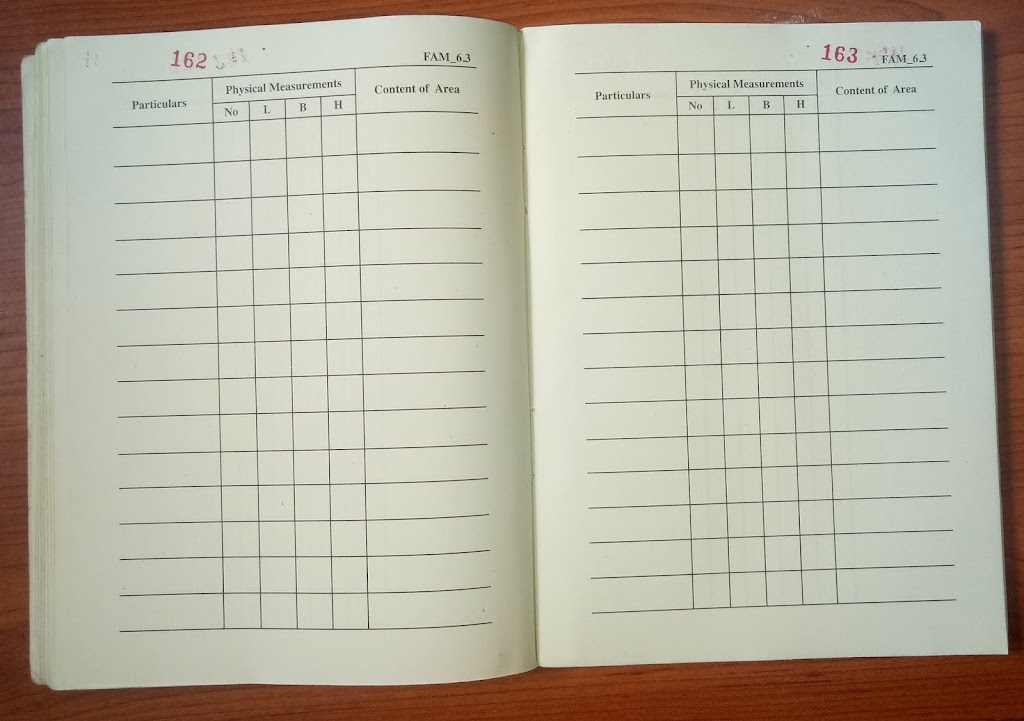
The measurement books should contain the “physical measurement table” on every page as shown in the picture below. Nevertheless, the MB can come in any size, as shown in the photograph above. Some of the department has also started to use soft MB. This type of MB is either created in an Excel sheet or other software like construction manager software (CMS). All the physical measurements are jotted down in the table provided.
| Particulars | Detail of Actual Measurement | Contents of Areas | |||
|---|---|---|---|---|---|
| No. | L | B | H | ||
| 1. Earthwork in excavation of tranches … | |||||
| -Long wall | 2 | 30.00 | 0.20 | 1.00 | 12.00 cum |
| -Short wall | 2 | 14.00 | 0.20 | 1.00 | 5.60 cum |
| Total Quantity | 17.60 cum | ||||
Recommended Reading: Site Order Book in Construction: Importance, Purpose & Uses in Project Management
Measurement Book Entry Types
A measurement book can be used for either of the following:
In Case of Work Done:
In the case of work done at the site, the following records shall be filled:
- Work description
- Exact measurement
- Exact quantities
- Unit of measurement
- Rate of the work performed
- The total amount to be paid for the work done
In Case of Material Supply:
In the case of material supplied at the site and office, the following records shall be filled:
- Item description (including manufacture date, model number, etc.)
- Exact quantities supplied
- Unit supplied product
- Rate of the supplied product
- The total amount to be paid for the supplied product
★ The perishable materials (such as cement, paints, chemical admixtures, etc.) are not admissible for secured advance and are not required to be entered in the Measurement Book (MB) for this purpose.
Recommended Reading: Retention Money in Construction Contract.
Standard Measurement Book (S.M.B)
A measurement book where the detailed measurements of certain items of work of a building are recorded correctly in ink on the completion of the construction and the accuracy of which is certified by an Assistant Engineer, is known as the Standard Measurement Book (Dutta, p. 699). The book is maintained as a record to facilitate the preparation of estimates for periodical repairs and their execution.
In the case of annual whitewashing, colour washing, etc., no detailed measurements need to be taken. The contractor’s bills are prepared, and payments to the contractors are made based on the measurements in the Standard Measurement Book. S.M.B. is checked every five years and alternation, if any, is entered in the S.M.B., which is known as quinquennial checking. The S.M.B. is mainly used for annual repair and maintenance works. It is used and maintained in the same manner as an ordinary measurement book.
Recommended Reading: Types Of Estimates in Construction Projects
Important point:
The measurement book (MB) should be handled carefully, and the following points should be kept in mind.
- All the records entered should be done with an ink pen. It is not prohibited to use pencils. The use of pencils is only allowed where there is no availability of pens during the time of record entry.
- Measurement Books should contain pages from 0 to 200. These pages should not be torn out or misplaced from the booklet.
- The book should not be lost or misplaced. Otherwise lost due to the unavoidable circumstances of the disaster, the book must be replaced immediately.
- No blank page or pages should be left in the middle of the book during the entry of records.
- The book should be kept safely under lock and key. It should hold the records entry for 10 years.
- The records in the books shall be clear and visible. The record entry should not be damaged by water or the spread of the ink.
Recommended Reading: What Is Rate Analysis In Construction?: Analysis Of Rate.
Record of Entities in Measurement Books
The records mentioned in the measurement books are as follows: –
1. Project Details: –
These lists should be filled on the first page of MB.
- Name of the project/Works:
- Name of the Contractor:
- Cost of the project/works:
- Duration of the contract or project period:
- Commencement of project/work:
- Completion of the project /works:
- Address of the contractor:
- Date and validity of performance guarantee:
2. Record of Advance Payment: –
In any construction project, advances are requested by the contractor, and such advance payments made to the contractor are duly recorded in the MB.
- Record of Mobilisation advance and date of entry of the data
- Record of Materials/Secured advance and date of entry of the data
3. Records of Running Accounts Bill(s): –
- It shall contain the nomenclature of the Running Account Bills (e.g., 1st RA Bill, 2nd RA Bill, etc.), along with the corresponding date of entry.
- It should contain detailed measurements of work done to date
- Should record the cost abstract of RA bill(s)
4. Records of Final Bill: –
- It should contain the nomenclature of the Final Bill and the date of entry
- It should contain detailed measurements of the work done
- Should record the most abstract of the final bill
5. Records of Dedication and Recoveries: –
- All deductions, such as TDS (tax) and retention money, shall be deducted from every RA bill and final bill. This should be clearly mentioned in the MB.
- Mobilisation and Secured advances must be completely recovered before the payment of the final bill.
- An unsettled bill in the previous bill must be deducted or settled in the final bill recorded in MB.
6. Retention Release: –
Upon completion of the work and after the expiry of the Defect Liability Period (DLP), the retention money withheld from the Running Account Bills and/or Final Bill shall be released to the contractor, provided that the work is found free from defects and has been duly certified by the Engineer-in-Charge. The release of such retention money shall be subject to satisfactory rectification of any defects observed during the Defect Liability Period and shall be recorded appropriately in the Measurement Book (MB) and relevant records.
Every amount passed in the MB must be signed by the Contractor, Site Engineer/Assistant Engineer. The record should be checked by the section or sector Head and verified by the chief or Executive engineer. An accountant is required to sign the MB during the passing of any bill after being received from the respective engineer.
Making Corrections in the Measurement Book
The correction in the MB is not allowed unless done correctly. The following list is to be followed for correction.
- No crossing over the page with ink or pencil is allowed.
- The single strike of words, lines, or paragraphs is admissible with the initial near it.
- A single line strike with the signature nearby on the MB page is allowed if the record entry is found to be a mistake or mismatching the record intended to be entered.
Probation in Measurement Book
- MB users are not allowed to tear off the page.
- Not allowed to use correction fluid for erasing mistakes.
- Overwriting is not allowed in any writing or measurement.
Recommended Reading: Carpet Area, Built-Up Area and Super Built-Up Area: 3-Primary Terms for Real Estate
Frequently Asked Questions
Q: Is the measurement book confidential?
Answer: No, the Measurement Book (MB) is not strictly confidential, as it can be accessed by authorised personnel involved in the project, including engineers and contractors, during joint measurements. However, it is an official record document and must be handled carefully. It should be kept in a safe place under lock and key because it contains important site measurement records used for billing, payments, and audit purposes.
Q: Can anyone use a measurement book?
Answer: No, only the relevant project engineer is allowed to use the measurement book, depending on the type of work. For keeping the record and making payments for construction works, a measurement book is maintained by the assistant engineer.
Q: What is the difference between a measurement book and a standard measurement book?
Answer: A measurement book is an account book to record the detailed measurements of the work done at the site. Whereas a standard measurement book is mainly used for annual repair and maintenance works for reference, which does not require measurement, especially in the case of repainting the building.
References & Standards
- Government of India, Central Public Works Department. (2019). Standard operating procedures for CPWD works manual 2019. Directorate General, CPWD. View Document
- Bureau of Indian Standards. (2003). Handbook Of Method of Measurement of Building Works.
- Wikipedia contributors. (2026, March 12). Measurement. Wikipedia. https://en.wikipedia.org/wiki/Measurement


Thanks for this article! It was incredibly helpful and really cleared up my confusion about MB entries.
Here in Bhutan, we now don’t have to maintain Hardcopy MB. Our measurement are all entered in Construction Manager Software which is web base system.
Solid content. Every new engineer should go through this before actually using MB and making the bill entry. It will surely minimize the errors of making the bill entry in the measurement book. Thanks for the content about MB.
Absolutely! A clear understanding of MB entries is crucial for new engineers, and minimizing errors saves a lot of time and hassle. Glad you found the content helpful!